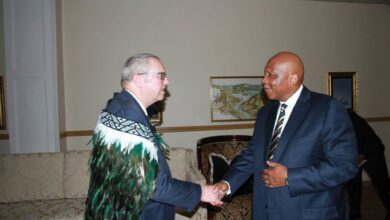
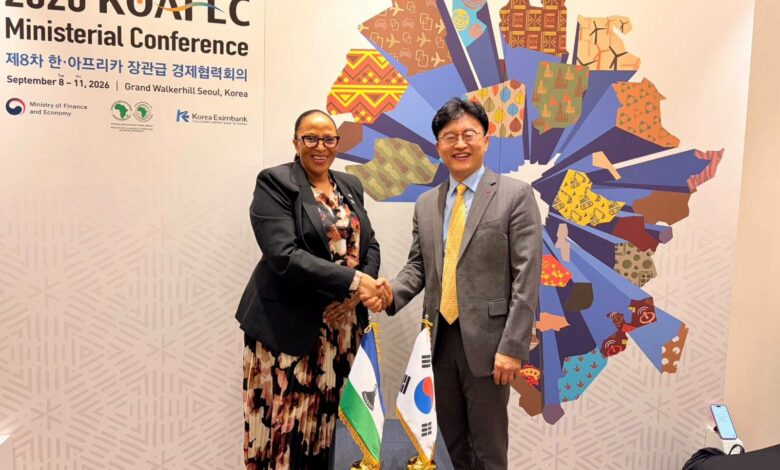
Lesotho and the Republic of Korea have reaffirmed their commitment to strengthening economic cooperation as the two countries explore new opportunities in technology, infrastructure and sustainable development. The commitment was reinforced during a bilateral meeting between the Honourable Minister of Finance and Development Planning of the Kingdom of Lesotho, Honorable Retšelisitsoe Matlanyane, and the Deputy Minister of Economy and Finance of the Republic of Korea, Dr. Jisung Moon. The meeting took place on the margins of the 2026 Korea-Africa Economic Cooperation, or KOAFEC, Ministerial Conference. Discussions focused on areas with the potential to support Lesotho’s economic development while deepening cooperation between the two countries. The engagement also carried added significance as Lesotho and South Korea commemorate 60 years of diplomatic relations in 2026.
The bilateral discussions covered a wide range of sectors that are central to Lesotho’s development priorities. Artificial intelligence and digitalisation featured prominently, reflecting the growing importance of technology in improving productivity, public services and economic opportunities. Healthcare and education were also identified as areas where stronger cooperation could contribute to improved outcomes and greater access to services. Agriculture, climate change and infrastructure development formed part of the broader discussions, alongside critical minerals, which have become increasingly important in global economic and industrial development. By bringing these sectors into the bilateral conversation, Lesotho and Korea are looking at cooperation from a broad development perspective rather than limiting their relationship to a single area of economic activity.
Artificial intelligence and digitalisation present significant opportunities for Lesotho as the country works to modernise its economy and public institutions. Digital technologies can support more efficient government services, improve access to information and create new opportunities for businesses and entrepreneurs. Artificial intelligence can also contribute to innovation in sectors such as healthcare, agriculture, education and financial services when countries establish the appropriate infrastructure and skills. For Lesotho, cooperation with a country that has extensive experience in technological development could provide access to knowledge and expertise that supports local capacity building. The discussions therefore reflect the potential for technology to become an important part of the country’s long-term economic development strategy.
Healthcare and education were also important components of the bilateral engagement. Strong healthcare systems require investment in infrastructure, skills, technology and access to reliable information, while education systems need to prepare people for changing economic conditions and emerging employment opportunities. Cooperation in these areas can support the exchange of knowledge and potentially introduce technologies and approaches that improve service delivery. Education also has a direct connection to digital transformation because countries need skilled people who can use and develop new technologies effectively. Strengthening cooperation in healthcare and education could therefore support both immediate development needs and the human capital required for Lesotho’s future economy.
Agriculture and climate change formed another important part of the discussions between the two countries. Agriculture remains closely connected to food security, livelihoods and economic resilience, making innovation in this sector particularly important. Climate change presents additional challenges for agricultural production and infrastructure, increasing the need for sustainable practices and improved resilience. Cooperation can help identify technologies and approaches that support more efficient use of resources while helping communities adapt to changing environmental conditions. Linking agricultural development with climate resilience could help Lesotho pursue economic growth while also addressing environmental challenges that affect communities and productive sectors.
Infrastructure development also remains essential to Lesotho’s economic ambitions. Roads, energy systems, telecommunications networks, water infrastructure and other essential facilities can influence the ability of businesses and communities to participate in economic activity. Improved infrastructure can reduce barriers to trade, support investment and make it easier to deliver essential services. Digital infrastructure has become particularly important as economies increasingly depend on connectivity for business, education, healthcare and government services. The inclusion of infrastructure development in the bilateral discussions demonstrates the importance of building the physical and digital foundations needed to support broader economic transformation.
Critical minerals were another area highlighted during the meeting, bringing an important economic dimension to the relationship between Lesotho and South Korea. Demand for critical minerals continues to attract international attention because many modern industries rely on mineral resources for technologies, manufacturing and energy-related applications. For Lesotho, cooperation in this area could create opportunities to explore how mineral resources can contribute to economic development while ensuring that the sector supports broader national interests. Responsible development requires appropriate investment, effective regulation, environmental considerations and local economic participation. Discussions around critical minerals therefore have the potential to open conversations about investment and value creation while encouraging a development approach that goes beyond the extraction of raw materials.
The Republic of Korea also encouraged Lesotho to make use of the Knowledge Sharing Program, known as KSP. The programme provides an avenue through which Lesotho can access Korean expertise and knowledge while developing projects that are aligned with its development priorities. The Korean side encouraged Lesotho to use the programme to develop viable projects and strengthen the groundwork needed for possible financing through the Economic Development Cooperation Fund, or EDCF. This approach could help Lesotho move from broad development priorities to more structured projects that can be assessed for implementation and potential financing. Access to technical knowledge and project development support can be particularly valuable when governments are seeking to turn ambitious plans into practical programmes.
The KSP and potential EDCF financing also demonstrate how technical cooperation and development finance can complement each other. Developing a viable project often requires careful planning, technical assessments and a clear understanding of economic and social benefits before financing can be considered. Knowledge-sharing initiatives can help strengthen these preparatory stages by providing access to expertise and experience. For Lesotho, this could improve the quality of projects presented for possible investment while strengthening institutional capacity to manage complex development initiatives. The connection between knowledge sharing, project preparation and potential financing creates a pathway through which bilateral cooperation could produce practical economic outcomes.
The meeting also reflects the broader importance of the 60-year diplomatic relationship between Lesotho and the Republic of Korea. Six decades of diplomatic relations provide a foundation for continued engagement while creating an opportunity for both countries to consider how their partnership can respond to contemporary development priorities. Economic cooperation today extends beyond traditional areas and increasingly includes technology, innovation, climate resilience, healthcare, education and strategic resources. The bilateral discussions show that both countries are interested in building on their longstanding relationship by exploring areas that can support future economic growth. The anniversary therefore provides an important moment to strengthen existing ties while identifying new opportunities for cooperation.
The bilateral meeting on the margins of the 2026 KOAFEC Ministerial Conference highlights Lesotho’s efforts to expand international economic partnerships and attract knowledge, investment and technological expertise. Minister Retšelisitsoe Matlanyane and Dr. Jisung Moon’s discussions covered sectors that have a direct bearing on Lesotho’s economic transformation, from artificial intelligence and digitalisation to agriculture, healthcare, education, climate change, critical minerals and infrastructure. Korea’s encouragement for Lesotho to use the Knowledge Sharing Program could provide a practical route for developing viable projects and preparing for possible EDCF financing. As both nations celebrate 60 years of diplomatic relations, the focus on practical economic cooperation gives their longstanding partnership renewed relevance. Continued collaboration could help Lesotho strengthen its development capacity, pursue innovative projects and build a more resilient and diversified economy.
Join 'Lesotho News' WhatsApp Channel
Get breaking Lesotho news — delivered directly to your WhatsApp.
CLICK HERE TO JOIN