Dr. Koetlisi Koetlisi, a GIZ Senior Adviser working alongside the ReNOKA team, is supporting communities in Lesotho as they develop practical skills to restore degraded landscapes and manage natural resources more sustainably. Currently based in Ribaneng, Dr. Koetlisi has been involved in training Community Watershed Teams in Tsakholo and Ribaneng. His work focuses on leadership, natural resource management, land rehabilitation and sustainable planning, with a strong emphasis on solutions that communities can apply using resources and knowledge available to them. Through these efforts, scientific knowledge is being connected with local experience to address some of the environmental challenges affecting Lesotho’s landscapes. His approach highlights the importance of empowering communities to become active participants in protecting and restoring the land they depend on.
As a soil scientist, Dr. Koetlisi brings specialised knowledge to the work of landscape restoration, particularly when it comes to understanding the condition and needs of soils. He describes himself as someone who speaks for “voiceless soils”, drawing attention to the critical role that soil plays in supporting life. Healthy soils provide the foundation for agriculture, vegetation and wider ecosystem functions, yet they can become severely degraded through unsustainable land use, erosion and other environmental pressures. When soil loses its ability to retain water and support plant growth, communities can face additional challenges in maintaining productive land. Protecting soil health is therefore an important part of efforts to improve livelihoods while strengthening the resilience of Lesotho’s landscapes.
Dr. Koetlisi believes that restoring degraded land does not always require expensive or complicated technologies. Instead, some solutions can come from proven community practices that have been used for generations and adapted to local conditions. This approach places communities at the centre of environmental restoration by recognising the knowledge they already possess. Scientific training can then complement that experience by explaining why certain practices work and how they can be applied more effectively. The combination of traditional knowledge and scientific understanding can create practical approaches that communities are more likely to understand, adopt and maintain.
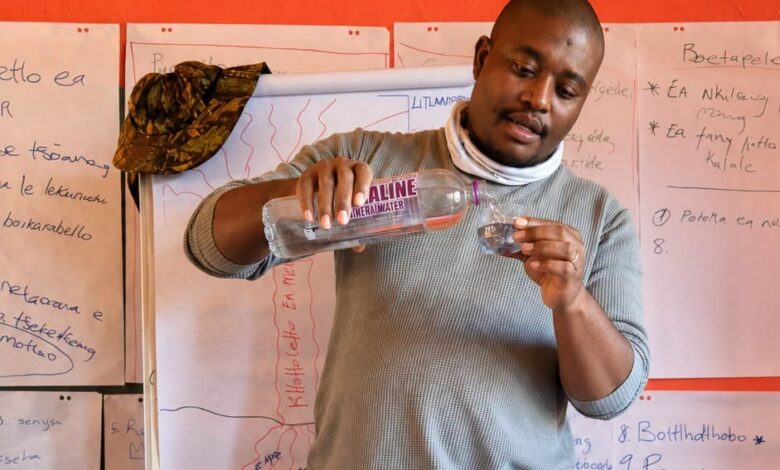
One of the practical examples used during the training involves well-composted kraal manure and its benefits for soil health. Participants are able to compare soil containing manure with soil without manure by adding the same amount of water to each sample. The demonstration provides a simple visual way to understand how organic matter can affect the soil’s ability to retain water. Soil enriched with organic matter can hold moisture more effectively, helping create conditions that support healthier plant growth. By using a straightforward demonstration rather than relying only on theoretical explanations, the training allows participants to see the difference for themselves.
The use of kraal manure also demonstrates how locally available resources can contribute to land rehabilitation. Organic materials can improve soil structure and increase the amount of moisture that remains available within the soil. This can be particularly valuable in areas where water availability and soil degradation create challenges for agricultural production and vegetation recovery. Properly composted manure can provide organic matter that supports healthier soil conditions when used appropriately. The training therefore gives community members a practical example of how existing resources can form part of wider efforts to restore land.
The Community Watershed Teams in Tsakholo and Ribaneng are receiving training that extends beyond soil management. Leadership is an important part of the programme because effective environmental restoration requires communities to organise, plan and work collectively. Participants are also being equipped with knowledge about natural resource management, land rehabilitation and sustainable planning. These skills can help communities identify environmental challenges and develop practical responses based on local conditions. Strong community leadership can also help ensure that restoration activities continue beyond individual training sessions and become part of longer-term local planning.
Watershed management requires cooperation because activities in one part of a landscape can affect communities and natural resources elsewhere. Soil erosion, water movement, vegetation loss and land degradation do not always follow community or administrative boundaries. This makes coordinated planning particularly important when communities are working to protect their landscapes and natural resources. Community Watershed Teams can help bring local stakeholders together to identify shared concerns and develop collective responses. Building their capacity can therefore support a more coordinated approach to protecting land and water resources.
For Dr. Koetlisi, one of the most valuable aspects of the training is seeing community members connect scientific information with their own experiences. This connection can make technical concepts easier to understand because participants can relate them to conditions they encounter in their fields and communities. Instead of presenting science as separate from local knowledge, the training creates space for both forms of understanding to inform one another. Community members can contribute observations based on years of experience while scientific principles help explain the processes behind those observations. This exchange can make environmental restoration more practical and relevant at community level.
The work also demonstrates why capacity building is important for sustainable environmental management in Lesotho. Providing communities with skills allows them to take greater responsibility for monitoring, protecting and restoring their natural resources. It also helps reduce the gap between environmental policy and what happens on the ground. When communities understand the reasons behind restoration practices, they can make more informed decisions about how to manage their land. Training that combines leadership, science and practical demonstrations can therefore contribute to stronger local ownership of environmental initiatives.
Dr. Koetlisi’s involvement with ReNOKA and the Community Watershed Teams reflects a broader focus on restoring Lesotho’s landscapes through community participation and practical action. His role as a soil scientist adds an important perspective to this work by placing soil health at the centre of discussions about land restoration. The demonstrations using kraal manure show that effective solutions can sometimes be simple, accessible and rooted in local practices. At the same time, the training provides scientific knowledge that helps participants understand the environmental processes behind these solutions. This combination can help communities develop restoration strategies that are both practical and sustainable.
The work taking place in Ribaneng and Tsakholo highlights the potential that exists when scientific knowledge and community experience come together. Dr. Koetlisi is helping participants develop skills that can support better leadership, responsible natural resource management and long-term land rehabilitation. His message about speaking for soils reinforces the importance of protecting a resource that is essential to life but often receives limited attention until degradation becomes severe. By showing participants the effects of organic matter through simple demonstrations, the training turns an environmental concept into something visible and understandable. As Community Watershed Teams continue to strengthen their skills, their efforts can contribute to healthier soils, better-managed natural resources and more resilient landscapes across Lesotho.
Join 'Lesotho News' WhatsApp Channel
Get breaking Lesotho news — delivered directly to your WhatsApp.
CLICK HERE TO JOIN