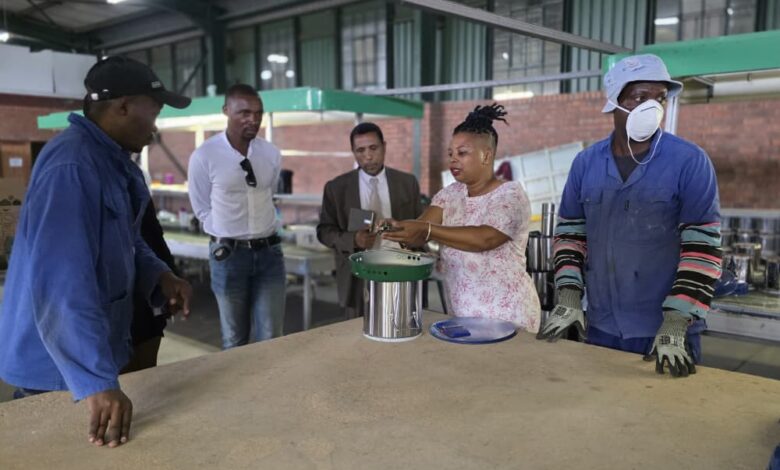
The Lesotho Renewable Energy Authority Management Team for the Renewable Lesotho: Access to Affordable and Renewable Energy (AARE) project, together with the UNDP Deputy Resident Representative, Taye Amssalu, visited the African Clean Energy (ACE) factory at Ha Thetsane Industrial Park in Maseru. The visit provided the team with an opportunity to tour the factory and observe the production of Improved Cooking Stoves (ICSs). The project demonstrates a strong commitment to delivering cleaner and safer cooking solutions to rural households across Lesotho. By integrating advanced manufacturing and sustainable energy distribution, the initiative addresses environmental concerns while improving public health and household safety. The hands-on tour allowed stakeholders to assess production processes and discuss strategies for scaling distribution to reach underserved communities efficiently.
Through the AARE project, the United Nations Development Programme is partnering with ACE to distribute ICSs, supporting families in the transition to low-emission cooking technologies. The project is funded by the European Union in Lesotho and aligns with the Government of Lesotho’s goal of expanding access to clean energy for both cooking and electricity. During the visit, discussions highlighted the importance of inclusivity, ensuring women, vulnerable groups, and marginalized communities fully benefit from these interventions. The collaboration emphasizes capacity building, local production, and sustainable energy adoption as key pillars for national development. By focusing on equitable access and community engagement, the initiative strengthens Lesotho’s renewable energy infrastructure while advancing social and environmental objectives.
The visit also underscored the role of partnerships in scaling renewable energy solutions. Government officials, project managers, and UNDP representatives explored opportunities to expand distribution networks, improve supply chains, and promote awareness about clean energy technologies. Stakeholders noted that access to ICSs not only reduces household air pollution but also lowers reliance on firewood, contributing to forest conservation and climate mitigation. The engagement highlighted how technology, funding, and policy support can converge to deliver tangible benefits to households, particularly in rural areas. The Renewable Lesotho initiative continues to position Lesotho as a leader in implementing affordable and sustainable energy solutions across Southern Africa.
Join 'Lesotho News' WhatsApp Channel
Get breaking Lesotho news — delivered directly to your WhatsApp.
CLICK HERE TO JOIN