Lesotho and South Korea Explore New Financing Opportunities for Energy and Digital Infrastructure

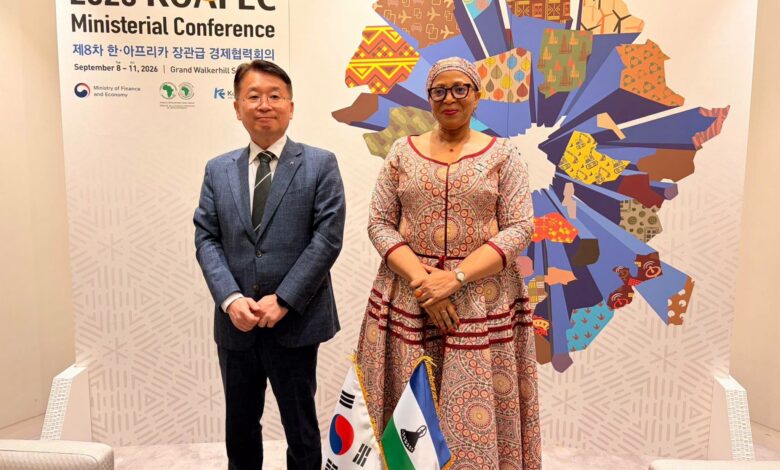
Lesotho is seeking to deepen its economic and development partnership with the Republic of Korea through new opportunities in concessional financing, renewable energy, technology and digital infrastructure. The Honourable Minister of Finance and Development Planning, Dr. Retšelisitsoe Matlanyane, held a bilateral meeting with Mr. Jung-hwa Seo, Executive Director and Head of the Economic Development Cooperation Fund Operations Group at the Export-Import Bank of Korea, known as KEXIM. The discussions focused on how the two countries can turn their longstanding diplomatic relationship into practical economic cooperation that supports Lesotho’s development priorities. Particular attention was given to financing opportunities through the Economic Development Cooperation Fund, as well as Korea’s Knowledge Sharing Program. The engagement comes as Lesotho explores new ways to finance strategic infrastructure and strengthen sectors that can contribute to long-term economic growth.
A major focus of the meeting was the potential use of EDCF concessional financing to support development projects in Lesotho. Concessional financing can provide governments with access to development funding on more favourable terms than conventional commercial borrowing, depending on the structure of the financing. For Lesotho, this creates an opportunity to explore funding models that could support large infrastructure projects while maintaining attention to debt sustainability. The discussions also considered the Knowledge Sharing Program as a possible starting point for developing projects with strong technical and economic foundations. Establishing viable project concepts before seeking major financing can help ensure that proposed investments respond to clear national priorities and have the necessary preparation for implementation.
Dr. Matlanyane highlighted Lesotho’s macroeconomic management and its record of meeting debt-repayment obligations during the engagement. She said these factors demonstrate the country’s readiness to move beyond predominantly grant-based cooperation towards concessional development financing. This position reflects Lesotho’s interest in expanding the range of financing instruments available for strategic development projects. A transition towards concessional financing requires careful project selection and financial planning because development investments must generate sufficient economic and social value to justify the resources committed. Lesotho’s emphasis on sound macroeconomic management also provides an important foundation for discussions with international development and financing institutions.
Renewable energy emerged as one of the key areas where Lesotho could strengthen cooperation with South Korea. Dr. Matlanyane highlighted the country’s potential in hydropower, solar and wind energy, pointing to opportunities to develop its natural energy resources more effectively. Lesotho’s mountainous terrain and renewable resources provide opportunities for expanding clean electricity generation while supporting broader regional energy needs. The country could also benefit from investment in infrastructure that improves its ability to generate, transmit and export electricity. This makes renewable energy a potentially important area for cooperation involving financing, technology transfer, technical expertise and private-sector participation.
The potential for electricity exports through the Southern African Power Pool was also highlighted during the meeting. Regional electricity markets can create opportunities for countries with renewable energy potential to supply power beyond their domestic markets. For Lesotho, developing additional generation capacity alongside stronger transmission infrastructure could support both domestic energy security and regional electricity trade. However, achieving these objectives requires significant investment in generation, transmission networks, grid connections and supporting systems. Cooperation with international partners could therefore help Lesotho develop projects that connect its renewable energy potential with wider regional electricity demand.
The discussions extended beyond energy to include technology, digital infrastructure and data-centre development. These areas are increasingly important to modern economies because reliable digital systems support government services, businesses, financial institutions, communication and access to information. Developing data-centre capacity could also strengthen the infrastructure required to support digital services and data-driven economic activity. For Lesotho, investment in digital infrastructure could contribute to improved connectivity and create opportunities for technology-related economic development. Cooperation with South Korea, a country with extensive experience in technology and digital development, could provide access to technical knowledge alongside potential financing and investment opportunities.
Mr. Seo advised that Lesotho could initially pursue Korea’s Knowledge Sharing Program to develop viable project concepts. Such an approach could allow the country to work with Korean expertise to assess project opportunities and develop proposals that are technically and economically sound. Once strong project concepts have been established, they could potentially provide a basis for further discussions on financing and implementation. Mr. Seo also pointed to opportunities for cooperation involving Korean companies, the Korea International Cooperation Agency, known as KOICA, and possible co-financing arrangements with the African Development Bank. These options could broaden the pool of technical and financial resources available to support Lesotho’s development priorities.
The recommendation to maintain engagement through diplomatic channels also highlights the importance of sustained bilateral cooperation. Major development projects generally require extensive preparation, consultation and coordination before financing and implementation can begin. Continued communication between Lesotho and South Korea can help maintain momentum as potential projects are identified, assessed and developed. Diplomatic engagement can also provide a platform for coordinating government institutions, development agencies and private-sector participants. This is particularly important when cooperation involves several institutions and financing partners with different mandates and requirements.
The meeting carries additional significance because Lesotho and the Republic of Korea are marking 60 years of diplomatic relations. Six decades of formal diplomatic ties provide a strong foundation for expanding cooperation beyond traditional development assistance. The latest discussions demonstrate an interest in building a partnership that produces practical outcomes in areas such as renewable energy, technology and infrastructure. Moving towards concessional development financing could also provide Lesotho with additional tools for implementing priority projects while strengthening its engagement with Korean institutions and companies. The focus on concrete sectors gives the longstanding relationship a new economic dimension that could benefit both countries.
For Lesotho, the opportunity to attract investment and development financing into renewable energy and digital infrastructure could support broader national development objectives. Projects in these sectors can contribute to improved infrastructure, economic activity and access to modern services when they receive appropriate planning and investment. The proposed approach also places emphasis on developing sound project concepts before committing significant financing, which can help reduce implementation risks. Collaboration with Korean institutions could bring technical expertise and access to established technologies while potential partnerships with organisations such as KOICA and the African Development Bank could strengthen project financing structures. The success of these opportunities will ultimately depend on Lesotho’s ability to develop bankable projects, maintain sound financial management and coordinate effectively across government and development partners.
The bilateral meeting between Dr. Matlanyane and Mr. Seo represents an important step in strengthening the economic relationship between Lesotho and the Republic of Korea. Discussions around EDCF concessional financing, the Knowledge Sharing Program, renewable energy, electricity transmission, technology and data-centre development have identified several areas with potential for practical cooperation. Lesotho’s hydropower, solar and wind resources could provide a foundation for expanded energy development, while investment in digital infrastructure could support the country’s transition towards a more connected economy. Continued engagement with KEXIM, Korean companies, KOICA and other development partners could help turn these opportunities into well-prepared projects. As the two countries mark 60 years of diplomatic relations, the focus on practical economic cooperation offers an opportunity to build on that history and create development partnerships that deliver tangible benefits for Lesotho.
Join 'Lesotho News' WhatsApp Channel
Get breaking Lesotho news — delivered directly to your WhatsApp.
CLICK HERE TO JOIN