Botho University And WASCO Partner To Give Students Practical Workplace Experience

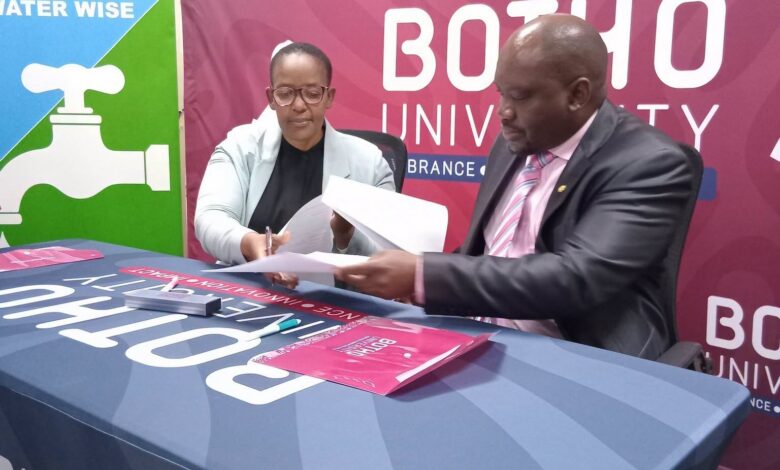
Botho University and the Water and Sewerage Company (WASCO) have entered into a partnership aimed at strengthening the relationship between higher education and industry in Lesotho. The collaboration is designed to give students greater exposure to real workplace environments while helping them apply academic knowledge to practical challenges. The partnership was formalised through the signing of a Memorandum of Understanding (MoU) in Maseru on Tuesday. Both institutions said the agreement should lead to practical programmes rather than remain a formal document with limited activity. The collaboration comes as employers increasingly seek graduates who can combine academic qualifications with practical skills and professional experience.
Speaking during the signing ceremony, Botho University Country Director Ms. Makhosi Hlalele described the partnership as a bridge between academia and industry. She said higher education could not operate as an isolated environment focused only on theory while communities and industries dealt with complex challenges in the real world. According to Hlalele, students need opportunities to confront genuine issues affecting the country and learn how their academic knowledge can be applied to those challenges. The partnership will give students exposure to areas such as sustainable water management, urban infrastructure resilience and digital transformation. She said the collaboration was particularly important at a time when the global labour market was changing rapidly.
Hlalele explained that Botho University follows what it describes as challenge-driven education, which encourages students to apply classroom learning to practical problems facing society. The approach places emphasis on developing graduates who can use their knowledge to understand problems, develop solutions and contribute to organisations and communities. Through its partnership with WASCO, the university will be able to connect this approach with the realities of a major organisation responsible for water and sewerage services. Students can gain a better understanding of the technical, operational and organisational challenges that exist beyond the classroom. The experience could also help them develop a clearer understanding of the skills and professional standards expected in the workplace.
Manager in the Faculty of Engineering and Technology at Botho University, Mr. William Nkomo, said the agreement represented an important step towards strengthening the connection between education and the world of work. He said the university wanted to produce graduates who were not only academically qualified but also had practical skills, professional competencies and experience. The partnership with WASCO is expected to create opportunities for students to gain exposure to real working environments while applying what they have learned through their studies. Nkomo said this type of engagement could help students become better prepared for employment and professional responsibilities. He also said the university could benefit from industry knowledge that would help it keep its academic programmes relevant to changing workplace needs.
The MoU provides for collaboration across several areas, including student engagement, experiential learning, research and innovation, professional development and knowledge sharing. It will also create opportunities for industry engagement, guest lectures and discussions around curriculum relevance. Graduate employment opportunities are another area identified through the partnership, creating a potential link between students’ academic development and their future careers. Nkomo said the arrangement could also give WASCO access to emerging talent while allowing the organisation to contribute its expertise to skills development. Such engagement can help create stronger communication between educators and employers about the capabilities graduates need when entering the labour market.
For students, the partnership could provide valuable opportunities to see how concepts taught at university are applied in professional settings. Practical exposure can help learners understand workplace processes, expectations and challenges while developing skills that may not be fully acquired through classroom study alone. Students involved in relevant projects may also have opportunities to learn from professionals working in water services, engineering, technology and related fields. Nkomo said the collaboration should ultimately create real opportunities for students rather than simply establish another institutional relationship. He stressed that the university wanted the partnership to be practical, mutually beneficial and sustainable.
The potential benefits also extend to WASCO, which can gain access to young talent and new perspectives through its engagement with university students. Nkomo said the organisation could contribute industry expertise while identifying graduates who may have the skills required to support its future development. This could create a more direct connection between students and potential employment opportunities. At the same time, WASCO can provide feedback about emerging skills requirements that may help the university strengthen the relevance of its programmes. The exchange of knowledge could therefore support both student development and institutional improvement.
WASCO Chief Executive Officer Mr. Lebohang Makara said the partnership comes at a time when the organisation is looking for new ways to improve its capabilities and respond to rapid technological developments. He said working with Botho University would allow WASCO to learn from younger people while giving students an opportunity to understand the realities of the workplace. Makara highlighted innovation and impact as important areas for the organisation as it seeks to improve the efficiency and effectiveness of its operations. He also pointed to the rapid development of technologies such as artificial intelligence as an area that organisations must understand and respond to. The partnership could provide a platform for WASCO to engage with students who have grown up using technologies that are now changing the way organisations operate.
Makara acknowledged that younger generations have developed different technological capabilities compared with previous generations. He said organisations need to recognise this change and consider how young people’s skills and perspectives can contribute to workplace development. The partnership with Botho University provides an opportunity for WASCO to engage with students who may bring fresh ideas to challenges facing the organisation. At the same time, students can learn from experienced professionals and gain a more realistic understanding of how organisations respond to operational and technological demands. This two-way exchange is central to the broader goal of connecting education with industry.
Both institutions also stressed the importance of turning the MoU into practical programmes and measurable opportunities. Makara said WASCO did not want the agreement to become another document that was signed and then left unused. He indicated that the organisation was committed to identifying ways in which the partnership could support its own development while also benefiting students. WASCO is also looking towards launching a programme under the partnership, which could provide a starting point for implementing the agreement. The focus on practical activities will be important in determining how much value students and the organisation gain from the collaboration.
The Botho University and WASCO partnership reflects broader efforts to strengthen links between higher education and industry in response to changing labour market demands. Employers increasingly require graduates who can demonstrate practical skills alongside academic qualifications, while universities need regular industry input to ensure their programmes remain relevant. Partnerships can help bridge this gap by creating opportunities for students to gain workplace exposure, participate in projects and interact directly with professionals. For WASCO, the collaboration provides an opportunity to engage with emerging talent while exploring new approaches to innovation and technological development. For Botho University students, it creates a pathway to gain practical experience and understand how their education can be applied to real challenges in Lesotho.
The success of the partnership will ultimately depend on how effectively both institutions implement the commitments outlined in the MoU. Student placements, experiential learning, research projects, professional development activities and industry engagement could turn the agreement into meaningful opportunities for young people. Continued cooperation will also allow Botho University and WASCO to identify areas where their shared knowledge and resources can address practical challenges. The emphasis from both institutions on action suggests that implementation will be central to the partnership’s value. By creating stronger connections between students, academics and industry professionals, the collaboration has the potential to support skills development while contributing to the development of a more work-ready graduate pool in Lesotho.
Join 'Lesotho News' WhatsApp Channel
Get breaking Lesotho news — delivered directly to your WhatsApp.
CLICK HERE TO JOIN