Lesotho Diplomatic Delegation Explores Italian Livestock Practices to Boost Domestic Agriculture

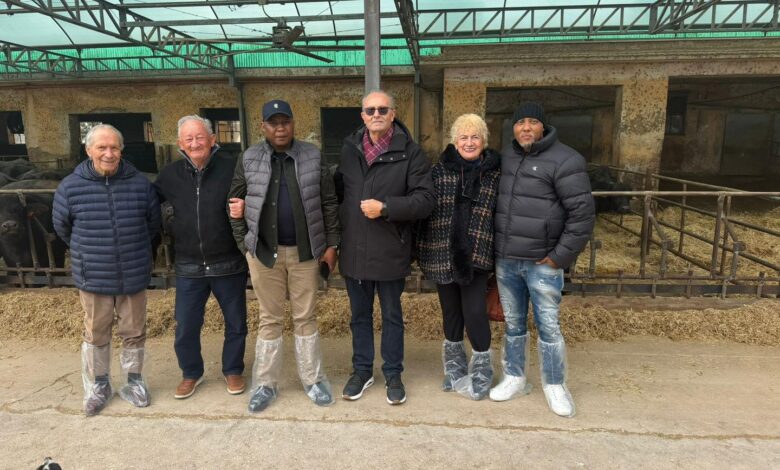
His Excellency Ambassador Lebeko Sello, accompanied by a delegation from the Embassy of the Kingdom of Lesotho in Rome, visited a livestock farm in Aprilia, Italy, to gain practical insights into advanced agricultural practices and explore strategies that could benefit Lesotho’s agricultural sector. The visit was part of a broader initiative to strengthen Lesotho’s food production capabilities and identify innovative methods for livestock management and value addition. The delegation’s engagement reflects Lesotho’s commitment to learning from international best practices to enhance productivity and competitiveness in local markets. By studying established systems abroad, Lesotho aims to identify scalable approaches that align with the country’s unique geographical and climatic conditions. This initiative also underscores the importance of international collaboration in improving national agricultural performance.
The delegation was warmly received by farm owner Mr. Giorgi Nello and Ms. Michelina Sanquest of Globe Trotters, who provided a detailed introduction to the farm’s operations. The visit began with a presentation on Lesotho’s geographical and agricultural context, highlighting challenges such as limited arable land, variable rainfall, and the importance of livestock for local livelihoods. The farm in Aprilia focuses on both livestock and horticulture, with a particular emphasis on buffaloes. These animals are raised for milk, mozzarella, other dairy products, and meat, with production aimed at both domestic consumption and export markets. The structured approach to livestock rearing and processing at the farm offered a practical demonstration of how integrated agricultural systems can generate diverse revenue streams.
Buffalo products at the Italian farm have gained significant recognition for their quality, nutritional value, and market demand. Milk and mozzarella are commercially processed and widely sold, while buffalo meat is exported internationally, including to the Philippines and multiple other countries. The delegation observed how efficient farm management, including diet optimization, health monitoring, and breeding practices, contributes to high-quality output. Insights into value addition, such as processing milk into cheese and other dairy products, illustrated how Lesotho could increase profitability within its own livestock sector. The Italian model demonstrates that careful planning, processing, and marketing can transform livestock production from basic subsistence into a competitive commercial enterprise.
The visit also emphasized the low cost of rearing buffaloes relative to the potential economic returns, highlighting an opportunity for Lesotho to explore similar models. Delegates were introduced to innovative techniques in pasture management, animal health, and sustainable farming practices that reduce waste and maximize yield. The nutritional profile of buffalo products, particularly their high protein and low-fat content, was noted as a key selling point for both local and global markets. By observing these practices firsthand, the delegation identified strategies that could strengthen Lesotho’s livestock management, improve food security, and provide pathways for export-oriented production. The exposure to international farming systems serves as a benchmark for domestic policy and program development in agriculture.
This engagement in Italy provides actionable lessons for Lesotho’s agricultural development strategy. Ambassador Sello and the delegation gained a deeper understanding of the integration between livestock management, value addition, and international market demands. By applying these lessons, Lesotho can enhance its livestock sector, diversify income streams for farmers, and tap into high-demand markets for buffalo-derived products. The visit reinforces the potential of international collaboration and knowledge exchange in driving sustainable agricultural growth. Ultimately, the delegation’s experience highlights a pathway for Lesotho to modernize its agricultural practices, increase productivity, and improve livelihoods for communities reliant on livestock farming.
Join 'Lesotho News' WhatsApp Channel
Get breaking Lesotho news — delivered directly to your WhatsApp.
CLICK HERE TO JOIN