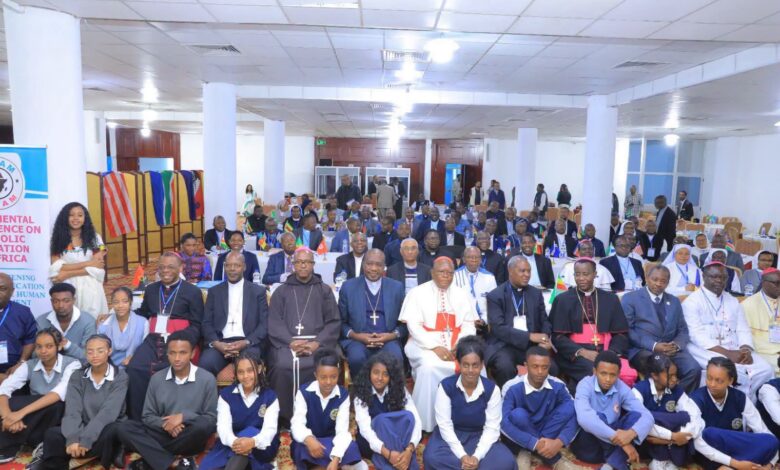
Lesotho has participated in the first-ever Continental Conference on Catholic Education in Africa, held in Addis Ababa, Ethiopia, from August 5 to 8, 2026. The landmark gathering brought together Catholic education leaders, bishops, academics, education specialists and strategic partners from across the continent to discuss the future of faith-based education in Africa. Lesotho was represented by the Archbishop of Maseru, His Grace Tlali Lerotholi, OMI, accompanied by Rev. Fr. Bereng Constantinus Mosuoe, Secretary of the Education Commission of the Lesotho Catholic Bishops’ Conference. Their participation placed Lesotho within a wider continental discussion about how Catholic education can contribute to human development and respond to Africa’s changing educational needs. The conference also created an opportunity for the country to share its experience while learning from Catholic education institutions and leaders from other African nations.
The conference was convened by the Symposium of Episcopal Conferences of Africa and Madagascar, known as SECAM, under the theme “Strengthening Catholic Education for Integral Human Development in Africa.” The theme reflected the conference’s focus on education as a tool that can contribute to the intellectual, moral, social and personal development of African communities. Participants examined how Catholic schools and universities can maintain their identity while responding to modern educational challenges and the broader needs of African societies. The gathering brought together bishops responsible for education, representatives of Catholic universities and religious congregations, education experts and strategic partners. This broad participation provided an opportunity for different institutions to exchange ideas and consider approaches that can strengthen Catholic education across the continent.
The inaugural conference followed resolutions adopted during the 20th SECAM Plenary Assembly in Kigali, Rwanda, in July 2025. Those resolutions called for stronger collaboration across the continent and a renewed strategic vision for Catholic education in Africa. The decision to convene a dedicated continental conference represented an effort to translate those priorities into a more coordinated approach to education. Greater collaboration can help Catholic education institutions share expertise, develop common strategies and respond more effectively to challenges affecting schools and universities. The conference therefore served as an important step towards building stronger links between Catholic education stakeholders in different African countries.
The decision to hold the first conference in Addis Ababa also carried considerable significance because the Ethiopian capital hosts the African Union and several major continental institutions. This location created an opportunity for Catholic education leaders to engage with broader African development conversations and consider how faith-based education can contribute to continental priorities. Education remains an important part of Africa’s development agenda because it influences employment, social mobility, innovation and the ability of young people to participate meaningfully in society. Dialogue between the Catholic Church and policymakers can help identify areas where faith-based institutions can complement national and continental education efforts. Holding the conference in Addis Ababa therefore provided both a symbolic and practical setting for discussions about the future of education in Africa.
A major area of discussion was the importance of strengthening Catholic identity within educational institutions. Catholic schools and universities have traditionally sought to combine academic learning with moral and values-based formation. Participants considered how institutions can preserve this identity while ensuring that students receive education that prepares them for the realities of contemporary African society. Maintaining a clear educational mission can help institutions develop graduates who possess academic knowledge alongside a strong sense of responsibility towards their communities. The discussions also recognised that Catholic education must remain responsive to changing social, economic and technological conditions while maintaining its core values.
Institutional leadership was another important focus of the conference, reflecting the need for effective management in Catholic schools and universities. Strong leadership can influence the quality of teaching, financial sustainability, staff development and student outcomes. Education institutions face increasingly complex demands, including technological change, resource constraints and the need to provide inclusive learning environments. Developing capable leaders can help Catholic institutions respond to these challenges while remaining accountable to their educational mission. The conference provided an opportunity for participants to exchange experiences on leadership approaches and consider how institutional capacity can be strengthened across Africa.
Teacher formation also featured prominently in the discussions because teachers play a central role in determining the quality of education students receive. Effective teachers require subject knowledge, professional skills and the ability to respond to different learning needs. In Catholic education, teacher formation can also include an understanding of the values and principles that underpin the institution’s educational mission. Investing in educators can therefore have a direct impact on both academic achievement and the broader development of learners. The conference’s attention to teacher formation highlighted the importance of supporting educators throughout their professional careers rather than focusing only on initial training.
Digital innovation was another significant issue addressed by participants as education systems across Africa adapt to technological change. Digital tools can expand access to learning resources, support new teaching methods and create opportunities for students to develop skills needed in modern economies. At the same time, institutions must consider challenges such as unequal access to technology, digital literacy and the cost of maintaining digital infrastructure. Catholic schools and universities can benefit from carefully adopting technologies that improve teaching and learning while ensuring that digital transformation does not exclude students who have fewer resources. The conference provided a platform for participants to consider how innovation can strengthen education while remaining aligned with institutional values and local realities.
The role of Catholic education in peacebuilding and social transformation was also explored during the gathering. Schools and universities can influence how young people understand diversity, responsibility, justice and peaceful coexistence. Education can provide students with the knowledge and skills required to participate constructively in their communities and contribute to resolving social challenges. Catholic institutions can play a role in promoting dialogue, respect and social responsibility through both classroom education and community engagement. The conference therefore considered education not only as preparation for employment but also as a means of developing responsible citizens who can contribute positively to African societies.
Lesotho brought its own experience to these continental discussions, particularly the historical role of faith-based institutions in the country’s education system. Catholic schools have long formed part of Lesotho’s educational landscape and have contributed to academic learning, moral formation and social development. The country’s experience provides an example of how religious institutions can work alongside broader national education systems to provide learning opportunities and develop young people. Lesotho’s participation allowed its representatives to share perspectives on the strengths and challenges associated with faith-based education. It also gave the country an opportunity to learn from experiences in other African nations that are working to strengthen Catholic education in different social and educational environments.
The conference also created opportunities for Catholic education institutions across Africa to strengthen cooperation and work towards greater continental coordination under SECAM. Stronger networks can make it easier for institutions to exchange knowledge, share successful practices and develop collaborative programmes. Continental cooperation can also help education leaders respond collectively to common challenges such as teacher development, digital transformation, institutional leadership and access to quality education. Developing a more coordinated framework could strengthen the contribution of Catholic education to national and continental development priorities. The discussions in Addis Ababa therefore provided a foundation for continued collaboration beyond the four-day gathering.
The participation of Archbishop Tlali Lerotholi and Rev. Fr. Bereng Constantinus Mosuoe highlighted Lesotho’s contribution to the broader African conversation on the future of education. Their involvement demonstrated the country’s continued engagement with efforts to strengthen quality, inclusive and values-based education. The first Continental Conference on Catholic Education in Africa also provided a space for Lesotho to share its experience while gaining insights that could inform future approaches to Catholic education. As African education systems continue to face technological, social and economic changes, cooperation between institutions will remain important. The conference in Ethiopia ultimately reinforced the idea that Catholic education can contribute to integral human development by combining academic excellence, responsible citizenship, moral formation and a commitment to the wider needs of African communities.
Join 'Lesotho News' WhatsApp Channel
Get breaking Lesotho news — delivered directly to your WhatsApp.
CLICK HERE TO JOIN