Lesotho has urged African countries to take immediate and coordinated action to protect schools, teachers and learners from the devastating effects of armed conflict, warning that disruptions to education pose a serious threat to the continent’s future. The Kingdom stressed that education must remain accessible even during times of conflict because it is essential for protecting children, supporting communities and promoting long term peace. The appeal was made during the 1357th Open Session of the African Union Peace and Security Council on Education in Conflict Situations, which brought together African leaders, policymakers and child protection experts. The meeting focused on addressing the growing impact of armed conflict on education across Africa and identifying practical solutions to safeguard children’s right to learn. Lesotho’s intervention reinforced the country’s commitment to advancing child protection and ensuring that education remains a priority during humanitarian crises.
The high level session was held at the African Union headquarters under the presidency of Algeria, which assumed the Peace and Security Council’s August 2026 leadership. The meeting was chaired by Ambassador Mohamed Khaled, Algeria’s Permanent Representative to the African Union, and attracted representatives from African Union institutions, Peace and Security Council member states, child protection bodies and international development partners. Participants reviewed the increasing number of conflicts affecting schools and educational institutions across the continent. They also discussed strategies to strengthen cooperation between governments, humanitarian organizations and regional institutions. The annual session highlighted the urgent need for African countries to work together to prevent further disruptions to education caused by violence and instability.
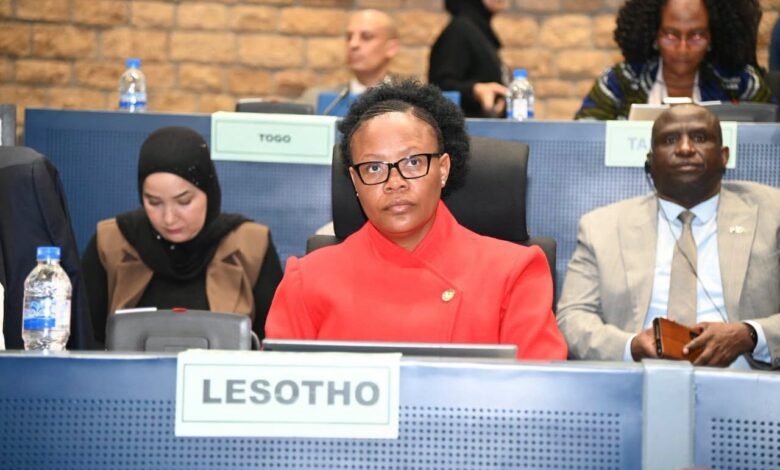
Representing Lesotho, Ambassador Nts’iuoa Sekete, Permanent Representative to the African Union and Vice Chair of the African Platform on Children Affected by Armed Conflict, delivered a strong message emphasizing that education must be viewed as an essential part of civilian protection and peacebuilding efforts. She warned that armed conflicts are destroying schools, forcing teachers and learners to flee their communities and denying millions of children access to education. According to Ambassador Sekete, these disruptions are not temporary setbacks but long lasting challenges that can deepen poverty, increase instability and contribute to future cycles of violence. She explained that when children are deprived of education, entire communities lose opportunities for development and economic progress. Her remarks underscored the importance of treating education as a humanitarian priority rather than a service that can be restored only after conflicts have ended.
Ambassador Sekete further called for stronger accountability measures to address attacks on educational institutions across Africa. She urged governments and regional organizations to systematically document, investigate and prosecute attacks on schools, violence against teachers and learners and the military occupation of educational facilities. She emphasized that accountability mechanisms at national, regional and continental levels are essential to deter future violations and protect children’s rights. The ambassador argued that every attack on a school represents not only an assault on infrastructure but also an attack on children’s hopes and future opportunities. Her recommendations reflected Lesotho’s determination to strengthen legal protections for education during times of conflict.
Lesotho also encouraged African governments to integrate education into early warning systems, humanitarian operations, peace support missions and post conflict reconstruction initiatives. Ambassador Sekete stressed that protecting education should not be treated as a separate issue but rather as a central part of conflict prevention and recovery efforts. She noted that countries enjoying peace have a shared responsibility to support children displaced by violence and conflict in other parts of the continent. According to her, no African child should lose the opportunity to receive an education because of circumstances beyond their control. This position reinforced the idea that education is a collective continental responsibility that extends beyond national borders.
The Kingdom further advocated practical measures to ensure learning continues even during emergencies. These recommendations included greater investment in temporary classrooms, community based learning centres, school feeding programmes, psychosocial support services and enhanced protection for teachers working in conflict affected areas. Lesotho also promoted the expansion of digital learning platforms and radio based education to reach children living in remote or insecure communities. In addition, the country called for accelerated education programmes to help learners whose schooling has been interrupted catch up with their peers. These proposals demonstrated Lesotho’s focus on finding realistic and inclusive solutions that can be implemented even under difficult circumstances.
Other participants at the African Union session echoed many of Lesotho’s concerns about the future of education in conflict affected regions. The Chairperson of the African Committee of Experts on the Rights and Welfare of the Child, Honourable Sabrina Gahar, called for stronger cooperation between institutions responsible for peace and security, education, humanitarian assistance and child rights. She argued that education cannot wait until conflicts have ended because it serves as both protection for vulnerable children and a foundation for long term recovery. Honourable Gahar also highlighted the heightened risks faced by displaced children, girls, children with disabilities and children formerly associated with armed groups. Her remarks emphasized that protecting education requires targeted support for the most vulnerable members of society.
Professor Gaspard Banyankimbona, African Union Commissioner for Education, Science, Technology and Innovation, focused on the importance of building resilient education systems capable of operating during emergencies. He explained that technology can play an important role in ensuring continuity of learning but cautioned that digital solutions alone are not sufficient. According to the Commissioner, successful education during crises depends on trained teachers, reliable infrastructure, appropriate educational content and systems capable of reaching communities without electricity or internet access. His comments highlighted the need for balanced investment in both technological innovation and traditional education support systems. Strengthening resilience, he said, is essential for protecting children’s education during future crises.
Ambassador Amma Twum Amoah, African Union Commissioner for Health, Humanitarian Affairs and Social Development, reinforced the importance of integrating education into broader humanitarian responses. She explained that children affected by conflict experience education, health, nutrition and protection as interconnected needs rather than separate services. As a result, humanitarian interventions must be coordinated, adequately funded and centred on restoring children’s dignity and supporting their full recovery. Her remarks encouraged governments and development partners to adopt more comprehensive approaches when responding to humanitarian emergencies. This integrated strategy was widely supported by participants at the meeting.
The session concluded with a strong condemnation of attacks against schools, teachers and educational personnel across Africa. Participants reaffirmed that all parties involved in armed conflicts must comply with international humanitarian law, international human rights law and African child protection instruments. They also called for stronger implementation of the Safe Schools Declaration and greater accountability for attacks on schools, the recruitment of children, gender based violence, forced marriage and other serious violations that prevent children from accessing education. Lesotho reaffirmed its commitment to using its membership of the African Union Peace and Security Council to advance child protection, inclusive education, preventive diplomacy and stronger early warning mechanisms. The Kingdom emphasized that protecting education during armed conflict is not only a humanitarian obligation but also an essential investment in Africa’s peace, stability and sustainable development, ensuring future generations have the opportunity to build a safer and more prosperous continent.
Join 'Lesotho News' WhatsApp Channel
Get breaking Lesotho news — delivered directly to your WhatsApp.
CLICK HERE TO JOIN