Kanono Ramashamole Calls for Stronger Collaboration and Practical Innovation at Lesotho’s 2nd National STI Forum

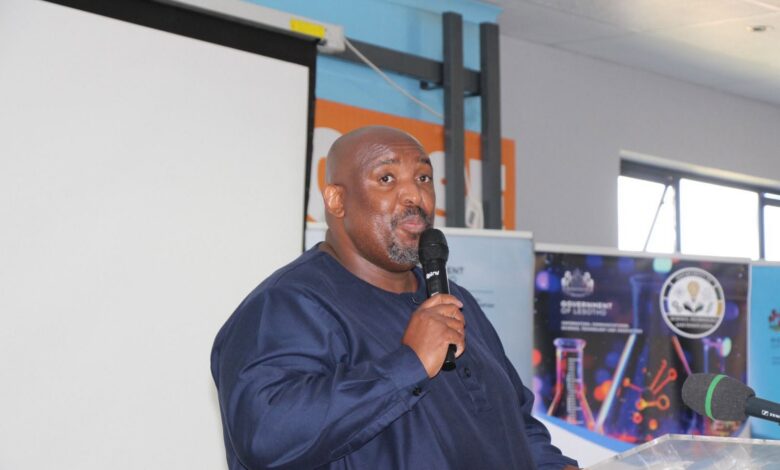
The Principal Secretary in the Ministry of Information, Communications, Science, Technology and Innovation (MICSTI), Mr Kanono Ramashamole, has called for stronger collaboration in science, technology and innovation to ensure that scientific knowledge translates into practical solutions that improve the lives of Basotho. Speaking on behalf of the Minister, Ramashamole officially opened the 2nd National Science, Technology and Innovation (STI) Forum in Maseru, emphasising the need for Lesotho to build a strong innovation ecosystem that supports sustainable development and inclusive economic growth. The forum, hosted by MICSTI through the Department of Science, Technology and Innovation, is being held under the theme “Harnessing the Biodigital Economy for Sustainable Development and Inclusive Growth in Lesotho.” In his opening remarks, he challenged stakeholders to move beyond discussions and focus on developing solutions that respond to the country’s social and economic needs. He stressed that science and innovation must become continuous national development priorities rather than activities limited to annual events.
Ramashamole used the official opening to highlight the importance of aligning Lesotho’s science, technology and innovation agenda with broader continental development commitments. He specifically pointed to the African Union’s Science, Technology and Innovation Strategy for Africa, known as STISA-2034, as an important framework for guiding the country’s efforts. He emphasised that Lesotho must translate these continental commitments into practical national programmes that strengthen research, develop technical skills, encourage innovation and create economic opportunities. According to his remarks, adopting strategies and making policy commitments is not enough without clear implementation plans. He called for stronger cooperation among government institutions, research organisations, universities and the private sector to ensure that national priorities produce meaningful results. This approach, he indicated, would help position science and technology as important drivers of Lesotho’s development.
A major issue raised by Ramashamole was the need to strengthen the connection between scientific research and practical economic applications. He emphasised that research should not remain confined to academic institutions or laboratories but should contribute to products, services and solutions that benefit society. This requires an innovation ecosystem that connects science education, research, entrepreneurship, commercialisation and industrial application. Universities and research institutions must work closely with businesses to identify challenges that require scientific solutions. Entrepreneurs and investors also need opportunities to support promising ideas and transform them into commercially viable products and services. Ramashamole’s message highlighted the importance of creating an environment where innovation can move from research and development into practical use.
Digital transformation was another key priority in his opening address. Ramashamole stressed that Lesotho must accelerate the adoption of digital technologies to strengthen its economy and improve service delivery. He highlighted the importance of advancing artificial intelligence, improving data governance and developing the technical capabilities required to participate in the global digital economy. Digital transformation can create opportunities across government services, education, healthcare, agriculture and business development. However, achieving these benefits requires appropriate infrastructure, skilled professionals and policies that support responsible technology adoption. He called for a coordinated national approach that ensures technological progress contributes to the country’s development priorities.
Ramashamole also placed particular emphasis on artificial intelligence as an emerging technology with the potential to address practical challenges in Lesotho. AI can support decision-making, improve access to information and help organisations manage complex tasks more efficiently. However, he recognised the importance of strengthening national capabilities to ensure that the country can benefit from these developments. Developing AI expertise requires investment in education, research, computing resources and data management systems. It also requires appropriate governance to address issues relating to privacy, security and responsible use. His remarks reflected the need for Lesotho to become an active participant in technological development rather than simply a consumer of solutions developed elsewhere.
Encouraging young people to pursue science and technology was another important part of Ramashamole’s message. He highlighted the need to develop a generation of skilled professionals capable of supporting the country’s growing technological ambitions. Young people can contribute to innovation through fields such as engineering, computer science, biotechnology, artificial intelligence and data analytics. Strengthening science education and providing practical learning opportunities can help prepare them for emerging careers. Collaboration between educational institutions, government and industry can also create pathways for young researchers and entrepreneurs to develop their ideas. Ramashamole’s call recognises that investing in young people’s scientific and digital skills is essential for building a sustainable national innovation ecosystem.
One of the central themes of his address was the potential of the biodigital economy to create new opportunities for Lesotho. Ramashamole explained that combining biological sciences, digital technologies, artificial intelligence and data analytics could support development across several sectors. These include agriculture, healthcare, environmental management and the creation of new products and services. The biodigital economy offers opportunities to improve productivity, strengthen research and develop innovative approaches to existing challenges. For Lesotho, the priority should be identifying applications that respond to local needs and can deliver measurable benefits. He encouraged stakeholders to explore how scientific knowledge and digital solutions can work together to support inclusive economic growth.
Agriculture emerged as one of the practical areas where Ramashamole sees opportunities for artificial intelligence and digital innovation. He announced that Lesotho is expected to launch an AI chatbot for agricultural extension services in December. The planned initiative is intended to support agricultural extension officers and improve farmers’ access to information. This development highlights the government’s interest in using emerging technologies to strengthen agricultural support services. An AI-powered chatbot could provide an additional channel for sharing agricultural information and assisting extension officers in their work. Its effectiveness will depend on the accuracy of its information, accessibility and how well it responds to the needs of agricultural communities.
The proposed agricultural AI chatbot also reflects Ramashamole’s emphasis on ensuring that technological innovation delivers practical benefits to ordinary citizens. Farmers need access to relevant information to make informed decisions about agricultural practices and respond to challenges affecting production. Digital tools can help improve communication and make useful knowledge more accessible. Agricultural extension officers also play an important role in interpreting information and providing guidance based on local conditions. The planned chatbot is intended to support these services through the application of artificial intelligence. This initiative demonstrates how innovation can be directed towards addressing specific development needs rather than focusing only on technological advancement.
Ramashamole further emphasised the importance of developing a national biodigital economy strategy that aligns with existing national development priorities and continental commitments. He cautioned against duplicating existing initiatives and called for better coordination among institutions working in related areas. A clear strategy can help establish priorities, identify opportunities and guide investment in research and technological development. It can also strengthen cooperation between government departments, academic institutions, businesses and development partners. By aligning different initiatives, Lesotho can make better use of available resources and avoid unnecessary duplication of efforts. His position highlighted the importance of ensuring that national innovation programmes work towards shared objectives.
Commercialisation was another issue Ramashamole challenged forum participants to address. He stressed that barriers preventing research and innovation from becoming commercially viable products and services must receive attention. Scientific discoveries and innovative ideas need appropriate funding, technical support, infrastructure and business partnerships to reach the market. Researchers must have opportunities to work with entrepreneurs and private sector organisations that understand market requirements. Investors also need platforms where they can identify promising innovations and support their development. Strengthening commercialisation can help create new businesses, support employment and increase the economic value of scientific research.
He also called on stakeholders to identify opportunities with the greatest potential to address Lesotho’s national challenges. Rather than spreading resources across too many unrelated initiatives, participants should consider where scientific and technological capabilities can make a meaningful difference. This requires identifying priority areas, understanding existing barriers and developing practical approaches to implementation. Government institutions must provide coordination and an enabling policy environment, while researchers and businesses contribute technical knowledge and innovation. Investors and development partners can support the process through funding and technical assistance. Ramashamole’s challenge placed responsibility on all stakeholders to ensure that the forum contributes to tangible national development outcomes.
The Principal Secretary also highlighted the importance of continuous collaboration beyond the duration of the forum. He stressed that science and innovation should not become isolated activities that attract attention only during annual gatherings. Instead, they should form part of ongoing national programmes supported by clear plans, institutional cooperation and sustained investment. This requires regular engagement between policymakers, researchers, educational institutions and industry. It also means following up on commitments and ensuring that promising initiatives receive the support needed to progress. His remarks reinforced the idea that building a successful innovation ecosystem requires long-term commitment rather than short-term activities.
As the official opening speaker, Ramashamole made it clear that the success of the 2nd National STI Forum should be measured by the practical results it produces. He challenged participants not to focus only on the number of presentations delivered or people attending the gathering. Instead, he urged them to consider the decisions made, partnerships established and actions taken to advance science and innovation in Lesotho. This approach places implementation and accountability at the centre of the national innovation agenda. It also encourages participants to develop commitments that can continue beyond the forum. His closing message called for a shift from discussing opportunities to actively creating solutions.
The opening of the 2nd National Science, Technology and Innovation Forum under Kanono Ramashamole’s leadership has placed renewed attention on the role of science, technology and innovation in Lesotho’s development. His message focused on stronger collaboration, practical research applications, artificial intelligence, youth participation and the development of a competitive biodigital economy. The planned AI chatbot for agricultural extension services provides an example of how emerging technologies could be applied to address local needs. His emphasis on national coordination and commercialisation also highlights the importance of turning scientific knowledge into economic and social benefits. Ultimately, Ramashamole challenged stakeholders to ensure that the forum produces lasting results through meaningful partnerships, practical decisions and sustained action that improves the lives of Basotho.
Join 'Lesotho News' WhatsApp Channel
Get breaking Lesotho news — delivered directly to your WhatsApp.
CLICK HERE TO JOIN