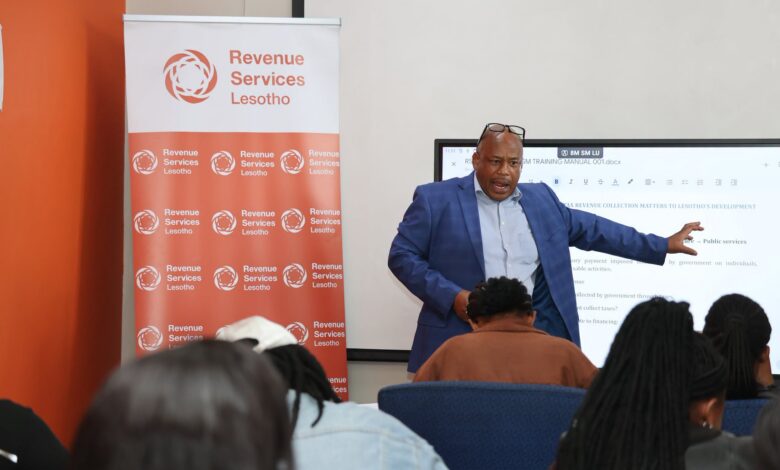
The Revenue Services Lesotho has commenced a two-day media training programme aimed at strengthening tax journalism and improving how journalists report on tax revenue and related public-interest issues. The training, themed “Strengthening Tax Journalism in Lesotho,” brings journalists together to build their understanding of taxation, revenue collection and the role these areas play in the country’s development. Veteran journalist and media expert Mr. Tsebo Mats’asa is facilitating the training, bringing professional journalism experience to discussions around effective reporting. The programme also introduces journalists to the mandate and broad functions of RSL while examining the importance of tax revenue to public services and fiscal stability. The initiative comes at a time when accurate and accessible reporting on public finances can help citizens better understand how government revenue affects the country and its communities.
A major focus of the training is improving journalists’ understanding of tax revenue and the systems connected to its collection. Taxation is an important source of government revenue and supports the financing of public services and national programmes. For journalists, understanding how revenue collection works can make it easier to explain complex tax issues to the public in clear and accurate language. Strong tax reporting also requires journalists to distinguish between facts, official statements, analysis and claims made by different stakeholders. By strengthening this knowledge, the training aims to help journalists produce reporting that gives audiences a clearer understanding of tax-related developments in Lesotho.
The workshop provides participants with an introduction to RSL, its mandate and its broad functions. This foundation is important because journalists need a clear understanding of the institutions they cover before they can effectively report on their activities and responsibilities. Knowledge of RSL’s role can help reporters ask more informed questions when covering tax administration, revenue collection and other related matters. It can also help journalists explain institutional responsibilities to audiences without creating unnecessary confusion about how the tax system operates. A stronger understanding of the institution can therefore contribute to more informed and meaningful tax journalism.
Tax revenue has a direct connection to Lesotho’s development because government revenue helps support the delivery of public services and the functioning of public institutions. When journalists report on taxation, they are often covering issues that affect businesses, workers, consumers and households. Changes in tax policy, revenue collection or compliance can generate significant public interest and require careful explanation. Effective reporting should give audiences enough context to understand what a tax measure means, who it affects and why it has been introduced. The training seeks to strengthen journalists’ ability to provide that context while maintaining professional reporting standards.
The programme also recognises that tax journalism involves more than reporting figures or repeating official announcements. Revenue data can contain technical information that requires careful interpretation before it can be presented to a general audience. Journalists may need to examine trends, compare figures, understand policy changes and ask questions about the factors behind changes in revenue collection. Accuracy becomes particularly important when reporting financial information because errors can create misunderstandings about government finances and economic conditions. Building stronger reporting skills can help journalists turn complex tax information into clear and useful public-interest stories.
Another key component of the training is the practical and responsible use of Artificial Intelligence in tax journalism. AI tools are becoming increasingly relevant to the media industry, with potential applications in research, information organisation, data analysis and other newsroom tasks. However, journalists still need to verify information and apply professional judgment when using AI-generated material. AI systems can produce incorrect, incomplete or misleading information, which means journalists cannot treat automated outputs as a substitute for verification. The training therefore places emphasis on using emerging technologies while maintaining accuracy, ethics and established standards of professional journalism.
The inclusion of AI in the programme reflects the changing environment in which journalists work. Modern newsrooms increasingly operate under pressure to process large amounts of information quickly while maintaining accuracy and credibility. AI can assist with certain tasks, but its usefulness depends on how journalists apply it and how carefully they check the information it produces. Responsible use requires journalists to understand both the opportunities and limitations of these technologies. For tax journalism in particular, careful verification is essential because financial information can have significant consequences for public understanding and decision-making.
The training also creates an opportunity for journalists to share their experiences and discuss challenges they encounter when covering tax-related issues. Day One was described as an engaging and interactive session, with participants actively contributing to discussions and exploring practical approaches to tax reporting. Such interaction can help journalists learn from one another and identify common difficulties in reporting on taxation and public finance. It can also create space for participants to discuss ways of presenting technical information in language that ordinary audiences can understand. Practical discussions of this kind can complement formal training by connecting the subject matter to real newsroom experiences.
The role of the trainer is also significant in shaping the practical nature of the programme. Mr. Tsebo Mats’asa brings experience in journalism and media training to the sessions, allowing participants to examine tax reporting from a professional newsroom perspective. Training led by an experienced media practitioner can help connect technical information with the realities journalists face when researching, writing and publishing stories. It can also encourage participants to think critically about sourcing, verification, context and responsible reporting. These skills are relevant not only to tax journalism but also to wider coverage of public institutions and economic issues.
The emphasis on responsible journalism is particularly important when covering public revenue. Journalists have a responsibility to provide information that audiences can understand and evaluate based on accurate facts. Reporting on taxation can involve sensitive issues, including government revenue, compliance, public spending and the financial responsibilities of individuals and businesses. Careful reporting can help avoid confusion while ensuring that legitimate public-interest questions receive attention. Strong tax journalism can therefore contribute to informed public discussion without compromising professional standards.
As the training moves into its second day, participants are expected to continue exploring practical approaches to tax reporting and the responsible use of emerging technologies. The first day has provided a foundation through discussions on RSL, tax revenue and the role of journalists in communicating public-interest information. The continuation of the programme provides further space for journalists to build on those discussions and strengthen their reporting skills. The broader objective is to ensure that journalists are better prepared to cover tax-related matters accurately, clearly and responsibly. Continued professional development can help journalists adapt to changes in both the tax environment and the rapidly evolving media landscape.
The RSL media training on “Strengthening Tax Journalism in Lesotho” highlights the important relationship between tax knowledge, journalism and public understanding. By improving journalists’ understanding of RSL, tax revenue collection and fiscal issues, the programme can help strengthen the quality of reporting on matters that affect national development and public services. Its focus on Artificial Intelligence also recognises the need for journalists to adapt to new technologies without abandoning accuracy, ethics and professional standards. The interactive nature of the training gives participants an opportunity to connect technical knowledge with practical reporting experience. As Day Two continues, the programme remains focused on building stronger tax journalism that can provide the people of Lesotho with clear, accurate and responsible information about public revenue and related issues.
Join 'Lesotho News' WhatsApp Channel
Get breaking Lesotho news — delivered directly to your WhatsApp.
CLICK HERE TO JOIN