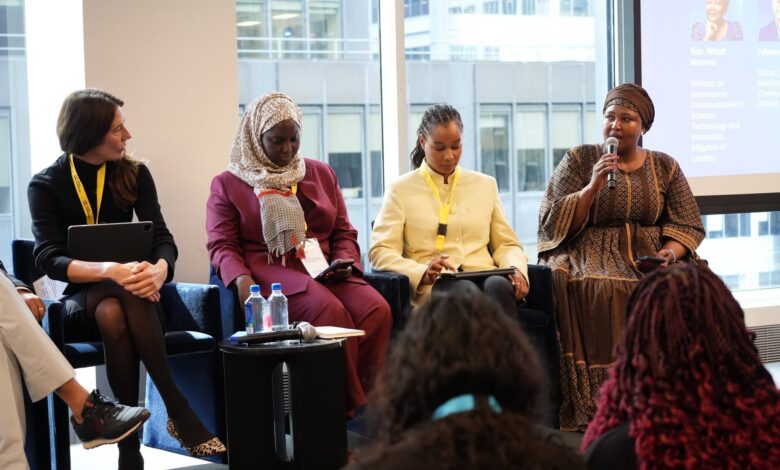
Lesotho continued to strengthen its engagement in global discussions on artificial intelligence and digital transformation on September 21, 2026, when Minister of Information, Communications, Science, Technology and Innovation Honourable Nthati Moorosi participated in a high-level panel at the 81st Session of the United Nations General Assembly in New York. The minister took part in a discussion titled “Introducing the AI Strategy Blueprint: Turning National Ambition into Action” during UN Digital Cooperation Day 2026. The session focused on the practical steps countries can take to move from national AI ambitions to implementation. It brought together government representatives, private sector stakeholders, civil society, academia and industry leaders. Lesotho’s participation placed the country’s emerging approach to artificial intelligence within a wider international conversation about digital cooperation and national technological development.
The discussion focused on how countries can build practical frameworks for artificial intelligence while strengthening their broader digital transformation efforts. AI is increasingly being considered in areas such as public services, education, business, research, infrastructure and economic development. However, developing an effective national approach requires more than adopting new technologies. Countries also need appropriate policies, skilled professionals, reliable digital infrastructure and systems that support responsible use of data. The UN Digital Cooperation Day discussions provided an opportunity for participants to examine how different stakeholders can work together to develop these foundations.
A key focus of the panel was the AI Strategy Blueprint and its role in helping countries turn national ambition into practical action. Strategy documents can establish priorities, but implementation requires clear responsibilities, resources and measurable steps. The Blueprint discussion therefore provided a platform for examining how countries can move from identifying the potential of AI to developing programmes and systems that can deliver tangible benefits. This includes strengthening national capacity so that governments and institutions can understand, deploy and manage AI technologies effectively. For countries such as Lesotho, building this capacity can form an important part of efforts to participate in the global digital economy.
Lesotho’s experience received particular attention because the country was presented as the first to apply the UN Blueprint for National AI and Data Strategies. This provided an opportunity to share lessons from the process of translating national AI ambitions into practical action. The experience also placed Lesotho within an international exchange involving countries and organisations examining how AI strategies can be developed and implemented. Sharing these lessons can help highlight both the opportunities and practical considerations involved in developing a national AI framework. It also demonstrates the importance of adapting international approaches to a country’s own development priorities, institutional environment and available capacity.
The focus on data was also important because effective AI systems depend heavily on access to reliable and appropriately managed information. National data strategies can help establish how information is collected, managed, shared and used across different sectors. Strong data governance can support innovation while addressing issues related to security, privacy, accountability and responsible technology use. For Lesotho, developing stronger national capacity in these areas could support the wider adoption of digital tools across government and the private sector. It can also help create an environment where researchers, entrepreneurs and institutions can explore new applications of AI using appropriate data and governance structures.
The involvement of government, business, civil society, academia and industry leaders reflected the broad cooperation required to develop a functioning digital ecosystem. Governments play an important role in policy development, regulation and public investment, while the private sector can contribute technology, innovation and investment. Universities and research institutions can help develop skills and generate knowledge, while civil society can contribute perspectives on how digital technologies affect communities and citizens. Bringing these groups together allows discussions about AI to extend beyond technology itself. It creates space to consider how digital transformation can support economic opportunities, public services and national development while addressing practical challenges.
Building national capacity remains another important consideration for Lesotho as artificial intelligence develops. The successful use of AI requires people with skills in areas such as data science, software development, cybersecurity, research and digital policy. Strengthening these capabilities can help countries reduce dependence on external expertise and create opportunities for local innovation. Education and training will therefore remain important components of any national AI strategy. Creating opportunities for young people, researchers and technology entrepreneurs to develop relevant skills could also support the growth of Lesotho’s digital economy.
Lesotho’s participation at the United Nations General Assembly also reflects the growing importance of international cooperation in shaping the future of artificial intelligence. AI technologies cross national borders, while questions around data, digital infrastructure, regulation and responsible innovation often require cooperation between countries. International platforms can provide governments with opportunities to exchange experiences, identify common challenges and learn from different approaches. For Lesotho, sharing its experience with the UN Blueprint can contribute to this broader exchange while providing opportunities to learn from other countries and stakeholders. Such cooperation can help ensure that national digital strategies remain connected to wider developments in technology and digital governance.
The September 21 panel also demonstrated that the conversation around AI is moving towards implementation. Countries are increasingly considering how strategies can translate into policies, skills programmes, infrastructure investments and practical applications. For Lesotho, the experience of applying the UN Blueprint provides a foundation for continued work on its national AI and data priorities. The next stage will involve maintaining coordination among institutions and ensuring that national ambitions are supported by appropriate resources and expertise. Continued engagement with international partners can also provide opportunities to strengthen this process.
Lesotho’s participation in UN Digital Cooperation Day 2026 highlighted the country’s growing engagement with artificial intelligence, data strategies and digital transformation. Minister Nthati Moorosi’s contribution to the AI Strategy Blueprint panel provided an opportunity to share Lesotho’s experience as the first country to apply the UN Blueprint for National AI and Data Strategies. The discussion reinforced the importance of turning national ambitions into practical action through policy, investment, skills development and cooperation. As AI continues to influence economies and public institutions around the world, Lesotho’s approach will depend on how effectively it develops the capacity and systems needed to use these technologies. The UNGA 81 engagement therefore provided another platform for Lesotho to contribute to the international digital cooperation conversation while advancing its own national AI agenda.
Join 'Lesotho News' WhatsApp Channel
Get breaking Lesotho news — delivered directly to your WhatsApp.
CLICK HERE TO JOIN