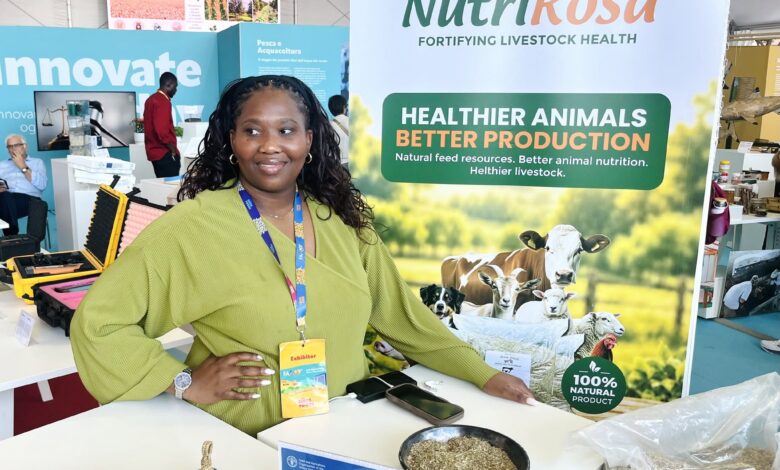
Lesotho’s agricultural innovation is gaining international attention through the work of entrepreneur Thakane Mahase, founder of Nutri Rosa, who represented the country at the Food and Agriculture Organization of the United Nations (FAO) Seeds2Foods Exhibition in Rome, Italy, from 8 to 12 October 2026. As part of the World Food Day celebrations, Mahase was recognised as a Food Hero for her efforts to develop natural animal nutrition solutions using resources found in Lesotho. Through her business, she is working to support livestock and poultry production while helping farmers make informed decisions about animal feeding. Her flagship product, Rosa Boost, is designed to support animal nutrition, productivity and performance across several types of livestock. Her participation in the international exhibition provided an opportunity to showcase local agricultural innovation and share the Nutri Rosa story with a wider audience.
Mahase’s journey reflects the potential of local entrepreneurship to address practical challenges in agriculture while creating opportunities for rural communities. Animal nutrition plays an important role in livestock farming because the quality and balance of feed can influence animal growth, health, reproduction and productivity. Farmers need access to suitable feeding solutions that match the nutritional requirements of their animals and the resources available to them. Through Nutri Rosa, Mahase is focusing on natural animal nutrition products developed from resources found in Lesotho. This approach connects local innovation with the needs of farmers who depend on livestock for income, food and other essential household resources. Her work highlights how agricultural businesses can contribute to improving farming practices while exploring ways to make better use of locally available materials.
Rosa Boost is central to Nutri Rosa’s work in animal nutrition. The natural feed supplement is intended for use across a broad range of livestock and poultry systems, including cattle, sheep, goats, chickens and other poultry, pigs, rabbits and horses. By developing a product for different animal categories, Nutri Rosa seeks to serve farmers working in varied agricultural settings. However, feeding requirements differ according to species, age, body condition, production stage and other factors, so appropriate feeding decisions remain important. Farmers need to consider how any supplement fits into an animal’s overall diet and follow suitable feeding guidance. Rosa Boost’s presence at the Seeds2Foods Exhibition offered an opportunity to introduce this locally developed innovation to an international audience interested in food systems and agricultural development.
Natural animal nutrition is an important area of interest for farmers seeking practical ways to manage livestock feeding. Locally available resources may offer opportunities to develop products suited to particular farming conditions, provided their nutritional value, safety and effectiveness are properly assessed. For smallholder farmers, the cost and availability of feed can influence how effectively they maintain their animals throughout the year. Developing accessible feeding solutions could help address some of these challenges, although the benefits depend on the product, the animal’s needs and how it is used. Nutri Rosa’s focus on natural resources from Lesotho highlights the value of exploring local solutions to agricultural problems. It also draws attention to the need for responsible product development and clear information that allows farmers to make informed decisions about animal nutrition.
Beyond producing an animal feed supplement, Mahase is supporting farmers through educational activities designed to strengthen their understanding of livestock feeding. Nutri Rosa offers animal nutrition masterclasses, feeding webinars and customised livestock feeding plans. These services provide opportunities for farmers to learn about feeding practices and consider how different approaches may suit their animals and farming objectives. Access to practical information can be especially useful for farmers who need to manage limited resources while maintaining animal health and productivity. Customised feeding plans can also help address differences between farms, since the needs of a dairy herd may differ from those of sheep raised for other purposes. By combining a product with farmer education, Nutri Rosa is working to make animal nutrition knowledge part of its wider contribution to agricultural development.
Farmer education can play an important role in strengthening livestock production in Lesotho. Animals require suitable diets that provide the energy, protein, minerals and other nutrients needed for their particular stage of life and production. Poor feeding practices can affect growth and productivity, while excessive or unsuitable supplementation may create unnecessary costs or other risks. Training and access to reliable advice can help farmers assess their animals’ needs and use available feed resources more effectively. Webinars and masterclasses can also create opportunities for farmers to ask questions and exchange practical experiences, depending on how the sessions are organised. Through its educational services, Nutri Rosa is placing attention on the knowledge farmers need alongside the products they may use in their feeding systems.
Mahase’s participation in the FAO HASTEN Project and Business Incubation Programme has also formed part of her entrepreneurial journey. Business incubation programmes can help emerging enterprises strengthen their business planning, develop products and improve their readiness to reach customers and markets. For agricultural entrepreneurs, this support can be particularly relevant because turning an idea into a viable business often requires technical knowledge, market understanding and the ability to manage production and distribution. Mahase has used her interest in sustainable agriculture to develop Nutri Rosa into a growing agribusiness focused on animal nutrition and farmer support. Her participation in the programme places her work within broader efforts to encourage entrepreneurship and strengthen agricultural innovation. It also highlights the importance of support systems that help local businesses develop their ideas and explore opportunities beyond their immediate communities.
The Seeds2Foods Exhibition in Rome provided a platform for Mahase to present her work beyond Lesotho. International exhibitions can create opportunities for entrepreneurs to introduce their products, exchange ideas and learn about developments in food and agriculture. They can also help connect local businesses with organisations and audiences interested in sustainable production, livestock farming and agricultural enterprise. For a business such as Nutri Rosa, international exposure may create opportunities to explain its approach, gather feedback and explore potential partnerships. Participation alone does not guarantee new investment, commercial agreements or access to overseas markets, but it can help raise awareness of the innovation taking place in Lesotho. Mahase’s presence at the exhibition therefore represented an opportunity to bring a locally developed agricultural solution into a wider international conversation.
Her recognition as a World Food Day Food Hero also highlights the contribution that individual entrepreneurs can make to food systems. World Food Day draws attention to food security, agricultural livelihoods and the importance of building more sustainable ways to produce and access food. Livestock farming contributes to food systems by providing products such as meat, milk and eggs, while also supporting household incomes and rural economic activity. Better animal nutrition can form part of efforts to improve livestock production, although it must be supported by appropriate animal health care, good husbandry and access to other essential farming resources. Mahase’s work connects these issues by focusing on feeding solutions and practical education for farmers. Her recognition offers an opportunity to draw attention to the role of local businesses in addressing agricultural needs and supporting communities.
Agriculture remains an important source of livelihoods for many households in Lesotho, making improvements in livestock management relevant to rural development. Farmers may face challenges related to feed availability, seasonal conditions, production costs and access to technical advice. Businesses that respond to these needs can help expand the range of products and services available to farming communities. Nutri Rosa’s activities combine the development of a natural feed supplement with educational support intended to help farmers make better feeding decisions. This combination could contribute to stronger agricultural knowledge and more informed livestock management, depending on the quality, accessibility and practical use of the services provided. It also demonstrates how entrepreneurship can connect product development with the everyday needs of rural producers.
The use of resources found in Lesotho is another important aspect of Nutri Rosa’s approach. Developing agricultural products from local materials can create opportunities to explore domestic supply chains and build value around resources that might otherwise remain underused. Such an approach may also encourage greater interest in locally driven research and product development. However, the long-term sustainability of these activities depends on responsible sourcing, consistent product quality and evidence that the products meet relevant safety and performance requirements. Businesses must also consider production costs, reliable supply and the needs of the farmers they serve. By focusing on natural resources and animal nutrition, Nutri Rosa provides an example of how local entrepreneurship can explore practical solutions while contributing to discussions about sustainable agriculture.
Mahase’s work also brings attention to the relationship between agricultural innovation and community participation. Farmers are more likely to benefit from new products and methods when they can access clear guidance, ask questions and understand how the proposed solutions fit their circumstances. Educational services can help build this connection by giving farmers opportunities to develop knowledge rather than relying only on purchasing a product. Stronger communication between agricultural entrepreneurs and farming communities can also help businesses understand the challenges farmers face and identify areas where further support is needed. These relationships may contribute to the gradual improvement of farming practices and the development of services that respond to local conditions. For Nutri Rosa, farmer engagement is an important part of its stated approach to animal nutrition and agricultural development.
Thakane Mahase’s participation in the FAO Seeds2Foods Exhibition represents a notable opportunity to showcase Lesotho’s agricultural innovation on the international stage. Through Nutri Rosa and its Rosa Boost feed supplement, she is focusing on animal nutrition while supporting farmers through masterclasses, webinars and customised feeding plans. Her involvement in the FAO HASTEN Project and Business Incubation Programme has been part of her efforts to develop a growing agribusiness rooted in sustainable agriculture. Her appearance in Rome also brought attention to the role of local entrepreneurs in strengthening livestock farming, sharing knowledge and exploring opportunities for rural economic development. While the wider impact of her work will depend on continued development, product performance and farmer uptake, her journey demonstrates the potential of locally driven ideas to contribute to agricultural progress. Celebrating Mahase as a World Food Day Food Hero recognises her efforts to represent Lesotho and highlights the importance of supporting entrepreneurs who are working to address real needs within the country’s agricultural sector.
Join 'Lesotho News' WhatsApp Channel
Get breaking Lesotho news — delivered directly to your WhatsApp.
CLICK HERE TO JOIN