Keynote Address by the Right Honourable the Prime Minister of Lesotho at the National Leadership Forum Day 2 Highlights Accountability, Governance and National Development

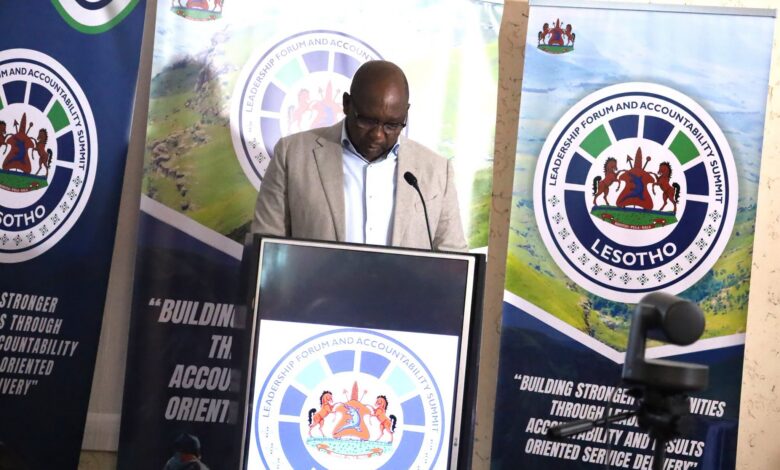
The second day of the National Leadership Forum marked a significant moment for Lesotho as the Right Honourable Prime Minister delivered a keynote address focused on strengthening governance, accountability and service delivery across the public sector. Addressing a distinguished audience that included His Majesty King Letsie III, senior government officials, heads of independent institutions, security agencies, development partners and members of the media, the Prime Minister reaffirmed his government’s commitment to building a capable, responsive and results-oriented state. The address served as both a reflection on progress made since the government assumed office in October 2022 and a roadmap for future reforms. Central to the message was the need for stronger accountability systems and better coordination among institutions. The speech underscored the importance of ensuring that public institutions deliver meaningful and measurable results for the people of Lesotho.
The Prime Minister reminded attendees that one of the core commitments made upon taking office was to strengthen accountability throughout the public sector. This commitment was later reinforced through the Speech from the Throne and remains a central element of the government’s reform agenda. According to the Prime Minister, accountability must go beyond policy statements and become embedded in everyday governance practices. Public sector performance should be clearly defined, monitored and reported transparently so that citizens can understand how government institutions are performing. He stressed that citizens deserve institutions that are effective, efficient and focused on delivering services that improve lives. By creating a culture where performance is regularly measured and openly discussed, the government aims to strengthen public trust and confidence in state institutions.
The address highlighted how the government’s vision aligns with key national, regional and international development frameworks. These include the National Strategic Development Plan II Extended, the Government Reforms Agenda, the African Union’s Agenda 2063 and the United Nations Sustainable Development Goals. Together, these frameworks provide a comprehensive vision for a Lesotho characterized by strong institutions, inclusive growth and improved living standards. The Prime Minister emphasized that achieving these goals requires more than simply having plans in place. Effective implementation, strong leadership and accountability are essential if development objectives are to become reality. The government views these frameworks as guiding tools that help shape policy priorities and ensure that national development efforts remain focused on measurable outcomes.
Reflecting on the state of governance when his administration took office, the Prime Minister acknowledged that many important systems, institutions and legal frameworks were already established. Significant work had been undertaken over the years to build structures for planning, budgeting, monitoring and service delivery. However, the existence of these systems did not always translate into effective outcomes. Many institutions operated independently of one another, leading to coordination challenges and implementation delays. Performance information was often underutilized in decision-making processes and accountability mechanisms did not consistently lead to better services for citizens. These shortcomings demonstrated that the challenge facing Lesotho was not necessarily the creation of new systems but the improvement and strengthening of existing ones.
To address these challenges, the government embarked on a deliberate effort to learn from countries that have achieved notable success in governance and public sector performance. The Prime Minister pointed to Rwanda as an important example, describing it as a sister nation with a globally recognized reputation for effective governance and accountability. Through study visits, policy exchanges and leadership engagements, Lesotho sought to understand how successful governments consistently deliver results. These interactions provided valuable lessons that have informed ongoing reforms. The strengthening relationship between Lesotho and Rwanda was highlighted as an example of constructive cooperation built on shared values and mutual learning. Such partnerships continue to play an important role in shaping governance reforms within Lesotho.
Several key lessons emerged from these international engagements. The Prime Minister noted that transformational change requires leadership that is united around a common vision and shared purpose. Strong accountability systems are equally important because they define responsibilities, track performance and ensure commitments are fulfilled. Effective governments also prioritize coordination and problem-solving across institutions rather than allowing organizational barriers to hinder progress. Another important lesson involves maintaining open communication with citizens and demonstrating tangible results. Public trust grows when governments engage transparently and show evidence of positive outcomes. These principles have become foundational elements of Lesotho’s governance reform agenda and have directly influenced the creation of the National Leadership Forum and the National Dialogue and Accountability Summit.
The Prime Minister explained that discussions held during the previous day’s Cabinet session revealed both achievements and persistent challenges. While progress has been recorded in several areas, obstacles related to coordination, implementation delays, resource utilization and performance management continue to affect government effectiveness. These issues often stem from broader governance weaknesses that limit institutional performance. As a result, the government recognizes that development ambitions cannot be achieved solely through additional funding, policies or plans. Instead, attention must be given to addressing the governance challenges that prevent institutions from operating at their full potential. The National Leadership Forum has therefore been established as a strategic platform where leaders can review performance, identify bottlenecks and agree on practical solutions.
A central theme of the address was the institutionalization of accountability and performance management across the public sector. The Prime Minister described the Forum as an opportunity to establish a new culture where transparency, accountability and service delivery are at the center of public administration. Leaders were encouraged to ask difficult questions about whether government commitments are being fulfilled, whether institutions are collaborating effectively and whether public resources are producing the intended results. These questions are designed to promote honest reflection and encourage continuous improvement. The Forum seeks to move beyond discussion and focus on actions that accelerate development and improve outcomes for citizens. By promoting regular performance reviews and collective problem-solving, the government hopes to create a more effective and responsive public sector.
Citizen engagement also featured prominently in the keynote address. The Prime Minister stressed that development cannot be imposed from above and must involve meaningful participation from the public. He referenced the Basotho saying “Lentsoe la sechaba ke poho,” emphasizing that the voice of the people carries authority and wisdom. Citizens are not simply recipients of government services but active partners in development. The upcoming National Dialogue and Accountability Summit will provide a platform for direct engagement between government and citizens. Through open discussions about achievements, challenges and future priorities, the government aims to deepen transparency and strengthen public participation in decision-making processes. This approach reflects a broader commitment to ensuring that governance remains people-centered and responsive to public needs.
The Prime Minister further emphasized that accountability is a responsibility shared across all public institutions. It is not limited to the Executive branch but extends to independent institutions, constitutional bodies, local authorities and state-owned enterprises. Regardless of their structure or mandate, all public institutions are ultimately accountable to the people of Lesotho. Public resources are funded by taxpayers, making transparency and responsibility essential obligations. The government intends for the accountability mechanisms established through the Forum and Summit to create a culture where performance is consistently assessed and reported. This broad approach recognizes that national development depends on the collective efforts of all institutions working toward shared goals.
Looking ahead, the government plans to conclude the process with a National Progress and Accountability Report, strategic resolutions, measurable commitments and a time-bound implementation framework. These outputs are intended to provide clear guidance for future action and create a basis for ongoing monitoring and reporting. Success will not be measured by the quality of discussions alone but by tangible improvements in governance, economic development and service delivery. The Prime Minister emphasized that the ultimate goal is to improve the daily lives of Basotho and ensure that institutions deliver meaningful results. He called on all participants to engage openly, think strategically and commit themselves to the transformation of public institutions. Strong leadership, he noted, requires integrity, professionalism and a willingness to lead by example.
The keynote address concluded with a powerful call for collective action and national renewal. The Prime Minister urged leaders to define governance through service, accountability and inclusion while ensuring that development benefits all citizens. He stressed that the future of Lesotho depends not only on the strength of its policies but also on the character and commitment of its leaders. By fostering trust, strengthening institutions and promoting citizen participation, the country can build a more prosperous and resilient future. The National Leadership Forum represents an important step toward achieving these objectives and creating a sustainable culture of accountability. Through collaboration, transparency and responsible leadership, Lesotho aims to realize its vision of a nation where institutions deliver results, citizens have a voice and every Mosotho has the opportunity to thrive.
Join 'Lesotho News' WhatsApp Channel
Get breaking Lesotho news — delivered directly to your WhatsApp.
CLICK HERE TO JOIN