Polihali Transfer Tunnel Marks Major Progress in Lesotho Highlands Water Project Phase II

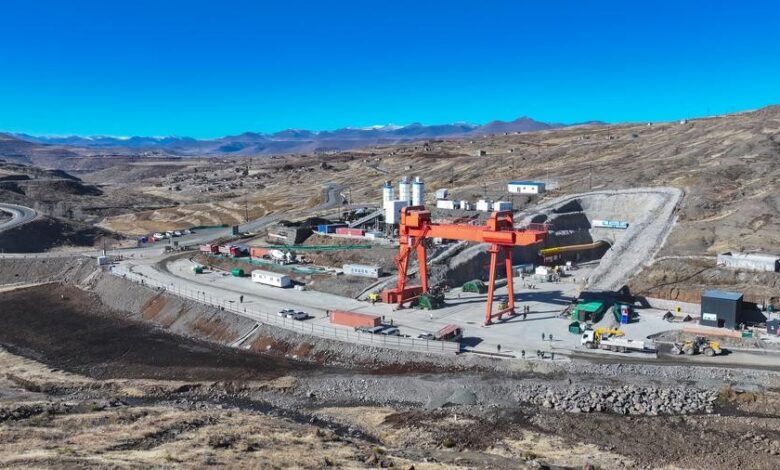
Maseru, Lesotho – July 14: As the icy winter nights settle across Lesotho’s northern highlands, the Polihali Transfer Tunnel construction site remains a symbol of determination and progress. The tunnel is a key feature of Phase II of the multi-phased Lesotho Highlands Water Project (LHWP) — a cross-border infrastructure initiative that is transforming not just the physical landscape, but the socio-economic outlook of the region.
At the heart of the activity is a 38-kilometre tunnel being excavated using two state-of-the-art hard-rock shielded Tunnel Boring Machines (TBMs). These machines are operating simultaneously from the Polihali and Katse ends of the tunnel, which will connect the new Polihali Dam to the existing Katse Dam, eventually supplying water to South Africa’s Gauteng province and surrounding regions.
Julius Topo, Site Manager for the tunnel excavation, confirmed that construction is running 24 hours a day with three rotating shifts. “We have deployed round-the-clock operations,” he said, noting that the schedule is critical to meeting the 2028 completion target.
Earlier this year, the first TBM began its work from the Katse side. On July 5, the second TBM was officially launched during a ribbon-cutting ceremony at the Caledonspoort Border Post in Butha-Buthe District. Manufactured in China and transported via Durban, the machine is now being assembled at the Polihali site.
Speaking at the ceremony, South Africa’s High Commissioner to Lesotho, Constance Seoposengwe, said: “The Lesotho Highlands Water Project is more than just a water project. Local jobs have been created, and new roads have been built in the Kingdom.”
Constructed by Kopano Ke Matla (KKM) — a joint venture between China’s Yellow River Company, Sinohydro Bureau 3, and South Africa’s Unik Civil Engineering — the project has brought substantial local benefits. KKM, which means “unity is strength” in Sesotho, employs a multicultural workforce of locals and international specialists working side by side.
Veteran engineer Topo, who also worked on Phase I in the 1990s, is now mentoring a new generation of engineers and technicians. “TBMs were used in Phase I, but 30 years have passed. Now it is time for me to share my knowledge with local colleagues to enhance site organization,” he said. Chief Masiphola Sekonyela of the nearby village Tloha Re Bue echoed his sentiments: “Our people rely on farming and herding, but now they have jobs, better access to goods, and more options for the future. When I heard the Chinese would lead this project, I was excited. They work hard and know how to get the job done.”
Beyond job creation, the project is investing heavily in vocational training through a partnership with Tashie Training and Business Solutions. CEO Pride Mudzingwa explained that participants are categorized as unskilled, semi-skilled, or skilled to tailor the training effectively. Programs range from five-day workshops to three-year technical courses, covering plumbing, repairs, quality assurance, and more.
More than 500 workers have already completed their training. “We issue certificates recognized across Southern African countries,” said Rethabile Letsoalo, Community Liaison Officer. “This could be a once-in-a-lifetime opportunity for many, and we are grateful that our Chinese partners are giving it for free.”
The Polihali Transfer Tunnel is not just a triumph for engineering but a symbol of strong international cooperation. For young professionals like Mpoi Rankhethoa, a graduate from the Central University of Finance and Economics in China, it represents hope and opportunity. “We rarely have a project of this scale in Lesotho,” Rankhethoa said. “It is not the first time China and Lesotho have worked together, and it certainly won’t be the last.”
When completed, the tunnel will transport water via gravity from the Polihali reservoir to the Katse reservoir, then through the existing Phase I system, which includes the ‘Muela Hydropower Station, and eventually into South Africa’s Vaal River system — a vital source for the economic hub of Gauteng.
The Polihali Dam is the third dam planned under LHWP Phase II, part of a long-term vision that includes five large dams across remote rural regions in Lesotho and South Africa. While the current focus is on tunnel excavation and dam construction, the broader impact is undeniable — improved roads, jobs, training, and stronger bilateral ties between Lesotho and its neighbours.
As Lesotho pushes forward with this transformative infrastructure project, the Polihali Transfer Tunnel stands as a beacon of progress, unity, and opportunity in the heart of Southern Africa.
Join 'Lesotho News' WhatsApp Channel
Get breaking Lesotho news — delivered directly to your WhatsApp.
CLICK HERE TO JOIN