Polihali TBM Launch Marks Major Milestone in Lesotho Highlands Water Project Phase II

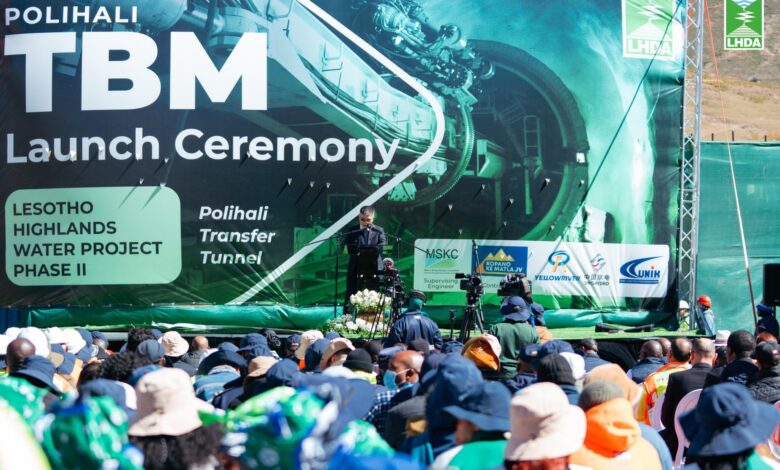
The launch of the newly named Polihali Tunnel Boring Machine Polihali TBM – Leboborane-la-Manyokola-Thita on 20 April 2026 represents a major step forward in regional water infrastructure development. The machine was officially launched by Minister of Natural Resources Hon Mohlomi Moleko alongside South African Minister of Water and Sanitation Hon Pemmy Majodina. It is now actively excavating the 38 metre Polihali transfer tunnel from the Polihali side as part of Phase II of the Lesotho Highlands Water Project. This development strengthens cooperation between Lesotho and South Africa in addressing long term water security needs. The project is designed to deliver water to Gauteng by 2029, making it one of the most important cross border infrastructure initiatives in Southern Africa.
The Polihali TBM will eventually meet its counterpart, the KHOITI-EA-‘NGOAHA-KHOLO2 TBM, which is advancing the tunnel from the Katse side. This coordinated excavation approach ensures precision alignment and efficient construction of the massive transfer tunnel. The meeting point of the two machines will mark a critical engineering achievement in the project timeline. The tunnel is designed to move large volumes of water from Lesotho’s highlands to South Africa’s economic hubs. This system is expected to improve water reliability for millions of people while supporting industrial and urban growth in Gauteng.
The launch of the second tunnel boring machine signals that construction has entered a more advanced phase, shifting from preparation to full scale excavation. According to project stakeholders, this marks the beginning of measurable progress in kilometres rather than preliminary site work. The Lesotho Highlands Water Project Phase II continues to expand its footprint as one of the largest infrastructure developments in the region. The introduction of advanced tunnelling technology increases efficiency and reduces construction risks. It also demonstrates the growing technical capacity being developed within the project’s engineering teams.
Officials involved in the project have emphasized that the TBM launch is more than a technical milestone. It represents long term planning aimed at strengthening water security and regional cooperation. The Lesotho Highlands Water Project is designed to benefit both Lesotho and South Africa through shared resource management. Water transfer from the mountainous regions of Lesotho to Gauteng supports economic stability and urban demand in South Africa. At the same time, Lesotho benefits from infrastructure investment, job creation and revenue generation linked to the project.
The Polihali transfer tunnel is a central component of this phase, forming a key link between major dam and reservoir systems. Once completed, it will play a critical role in regulating water flow between the two countries. Engineers are focusing on precision alignment to ensure the two tunnel boring machines meet accurately underground. This requires advanced surveying, monitoring systems and continuous coordination between teams operating on both ends of the tunnel. The success of this alignment will determine the efficiency and safety of the entire transfer system.
The Lesotho Highlands Water Project Phase II is widely regarded as one of the most ambitious water infrastructure programmes in Southern Africa. It builds on earlier phases that already supply significant volumes of water to South Africa. The introduction of modern TBM technology allows for faster excavation while maintaining high safety standards. It also reduces environmental disruption compared to traditional tunnelling methods. This approach reflects a shift toward more sustainable infrastructure development practices in the region.
As excavation progresses, expectations are rising that the project will meet its 2029 delivery target for water transfer to Gauteng. This timeline is critical for planning water supply in one of South Africa’s most populated and economically active regions. The success of the TBM operations will directly influence whether this target is achieved on schedule. Continuous monitoring and coordination between Lesotho and South African authorities remain essential. The project’s progress is closely watched by engineers, policymakers and communities that depend on its outcomes.
The launch of the Polihali TBM marks a defining moment in the evolution of the Lesotho Highlands Water Project Phase II. It confirms that large scale tunnelling operations are now fully underway and advancing steadily. The use of twin tunnel boring machines working from opposite sides highlights the scale and precision of the engineering effort. As excavation continues, the project moves closer to delivering long term water security for the region. The development stands as a major example of cross border cooperation, technical innovation and infrastructure driven growth in Southern Africa.
Join 'Lesotho News' WhatsApp Channel
Get breaking Lesotho news — delivered directly to your WhatsApp.
CLICK HERE TO JOIN