
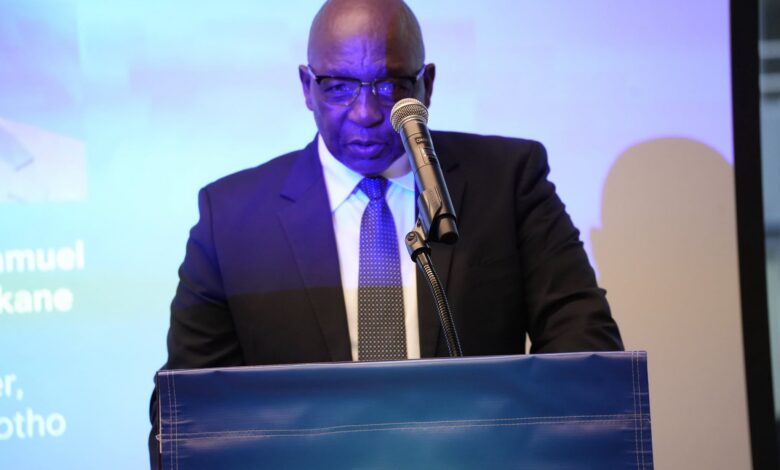
Lesotho is taking a practical approach to artificial intelligence as the country moves from developing digital strategies to implementing a national roadmap for AI infrastructure and capability. Prime Minister Samuel Ntsokoane Matekane outlined the country’s progress during the second UN Digital Cooperation Day 2025 in New York, where he opened a substantive session focused on introducing the AI Strategy Blueprint and turning national ambitions into action. His remarks highlighted Lesotho’s decision to engage with artificial intelligence as a development opportunity while recognising the infrastructure, skills, governance, financing and institutional capacity needed to use the technology effectively. Rather than treating AI as an isolated technology project, Lesotho is linking its digital ambitions to national development priorities and public services. The approach places emphasis on building capabilities that can respond to the country’s actual needs and available resources.
Matekane said artificial intelligence is expanding faster than any previous general-purpose technology, creating both opportunities and challenges for countries seeking to participate in the digital economy. Lesotho’s position is that the country should not approach AI with fear, but should use it responsibly and urgently in support of sustainable development. The Prime Minister stressed that technology by itself does not automatically produce economic or social progress. Infrastructure, institutions, skills, governance and investment all influence whether AI creates opportunities or contributes to existing inequalities. This perspective has shaped Lesotho’s decision to assess its national readiness before making major decisions about AI infrastructure and deployment.
A significant milestone in this process is Lesotho becoming the first country to apply the United Nations Blueprint for National AI Strategies. The Blueprint has provided a framework for assessing existing capabilities, identifying gaps and establishing priorities for implementation. According to Matekane, the process did not replace the country’s existing plans but helped validate decisions that had already been taken while providing a clearer structure for future action. This allowed Lesotho to move from broad discussions about artificial intelligence towards specific questions about infrastructure, compute capacity, data governance, skills and financing. The experience also demonstrated how an international framework can be adapted to the circumstances and development priorities of a smaller country.
Over the past year, the Government of Lesotho, through the Ministry of Information, Communications, Science, Technology and Innovation, conducted a comprehensive assessment of the country’s readiness for AI. The assessment identified several areas that require further development if Lesotho is to build sustainable national AI capability. These include digital infrastructure, computing capacity, data governance, institutional arrangements, skills development and long-term financing. The findings were also strengthened through Lesotho’s participation in the inaugural United Nations Global Dialogue on AI Governance in Geneva. That engagement reinforced the idea that the global AI divide is increasingly influenced not only by access to digital technologies, but also by access to compute, data, skills and institutions capable of governing and using AI effectively.
Lesotho is therefore seeking to position itself as more than a consumer of artificial intelligence products developed elsewhere. Matekane said the country is using its readiness assessment, the AI Strategy Blueprint and the Data Centre Blueprint to translate international discussions into practical national action. This approach recognises that meaningful participation in the AI economy requires more than purchasing technology. Countries also need the ability to manage data responsibly, develop suitable infrastructure, build human capacity and establish institutions that can oversee the use of emerging technologies. For Lesotho, these requirements are particularly important because investment decisions must take account of the country’s energy, water, financing, human capacity and geographic constraints.
The Prime Minister also emphasised that Lesotho did not start its digital transformation journey from zero. The country already had three validated digital policies, an operational government data centre and a designated Chief Digital Office before beginning the AI readiness process. These existing foundations had also helped identify areas where additional investment was required. However, having a data centre does not automatically mean that a country has the infrastructure needed to support artificial intelligence. AI applications can require significant computing resources, reliable connectivity, suitable data systems and specialised technical skills. Lesotho’s planning process is therefore focused on understanding what infrastructure is actually required rather than assuming that existing facilities can meet every future demand.
One of the central questions raised by the Blueprint was how Lesotho could develop digital infrastructure that supports its AI ambitions while operating within real national constraints. The country must consider the availability of energy and water, the cost of financing, the size of its technical workforce and the realities created by its geography. These factors influence the scale, location and design of digital infrastructure. Matekane said the value of the Blueprint was that it helped Lesotho strengthen its existing plans and sequence its decisions more effectively. This means the country can focus its resources on infrastructure and capabilities that have a clear connection to national development priorities.
The government’s approach begins with policies and services rather than infrastructure alone. Lesotho is identifying the services that matter most to its people before determining what technology and infrastructure are needed to improve them. This places practical outcomes at the centre of the country’s AI planning. Potential benefits can extend across agriculture, health, education, water management and public administration, where better data and digital systems could support improved decision-making and service delivery. The principle is that investments in technology should produce measurable benefits for citizens rather than exist simply as demonstrations of technological ambition.
This approach is particularly relevant for a country such as Lesotho, where resources must be allocated carefully. Matekane argued that digital infrastructure should respond to demand rather than being developed without a clear purpose. Lesotho does not need to replicate the digital infrastructure models of larger economies if those models do not reflect its own circumstances. Instead, the country is seeking to build capacity that corresponds with its resources, priorities and development requirements. The broader objective is to make digital infrastructure a foundation for national capability rather than an expensive standalone technology project.
Implementation has now become a central part of Lesotho’s AI agenda. With support from the UN Resident Coordinator’s Office, the United Nations Office for Digital and Emerging Technologies, the Global AI Capacity Development Network, UNDP, UNICEF, UNESCO and ITU, the country recently completed a five-day working session in Maseru. Matekane described the session as a practical exercise rather than a traditional conference. The work resulted in a roadmap supported by five concrete actions, with responsible institutions and timelines assigned to each action. The detailed actions are expected to receive further attention during the panel discussion connected to the Digital Cooperation Day session.
Lesotho’s National Compute Roadmap represents an important part of this shift towards implementation. The country is now advancing Phase One of the roadmap for the 2026 to 2029 period, with objectives, responsible institutions and a focus on developing long-term national capability. Computing capacity is becoming an increasingly important part of national AI readiness because governments and organisations need appropriate resources to develop, test and operate AI applications. For Lesotho, however, compute capacity is only one component of the broader digital ecosystem. The country also needs effective data governance, technical skills, institutional capacity, responsible AI practices and sustainable financing.
The government’s focus on national capability also reflects a wider concern about how developing countries can participate meaningfully in the global AI economy. Countries with limited resources can face barriers when advanced technologies depend on expensive computing infrastructure, specialised expertise and large volumes of high-quality data. Without appropriate investment, these gaps can limit the ability of governments to develop local solutions or participate in AI-related innovation. Lesotho’s strategy seeks to address these challenges through coordinated investment and partnerships while maintaining national ownership of its priorities. This could allow the country to focus its limited resources on areas where digital technology can deliver practical development benefits.
Matekane also highlighted the importance of international cooperation in supporting countries such as Lesotho through the AI transition. He noted that international assistance can sometimes arrive through separate channels, with different priorities, timelines and approaches. In Lesotho’s case, the involvement of different United Nations entities created an opportunity to coordinate expertise around priorities identified by the government itself. The UN Resident Coordinator helped bring together expertise from across the UN system around a shared understanding of Lesotho’s needs. This coordination provided a more unified approach to supporting the country’s digital transformation.
The experience also illustrates the potential role of the AI Strategy Blueprint beyond technology planning. According to Matekane, the Blueprint can serve as a coordination mechanism that allows governments and development partners to work from the same assessment of national needs. This can help reduce fragmented approaches and make it easier to align technical assistance, investment and capacity-building programmes. It also places the government in a stronger position to determine its own priorities rather than responding separately to different external initiatives. For developing countries facing limited resources, such coordination can be important when building complex digital systems that require contributions from multiple institutions.
Lesotho has acknowledged the contribution of several organisations and countries to the process. Matekane expressed appreciation to the United Nations Office for Digital and Emerging Technologies for selecting Lesotho as the first country to apply the Blueprint and for supporting the process. He also recognised the Executive Office of the Secretary-General, the UN Resident Coordinator’s Office in Lesotho, ITU, UNESCO, UNICEF, UNDP and the Global AI Capacity Development Network. The governments of Ethiopia and Senegal were also acknowledged for sharing expertise and practical lessons. Their involvement reflects the importance of cooperation and knowledge sharing as countries seek to develop AI capabilities suited to their own circumstances.
The next phase will test whether the plans developed through the readiness assessment and Blueprint can translate into sustained national capacity. Lesotho now has a defined sequence of priorities and a National Compute Roadmap covering 2026 to 2029. The focus has shifted from designing a strategy towards implementing specific actions through accountable institutions. This transition requires continued investment, coordination and technical capacity, while also ensuring that AI development remains connected to national development objectives. The government’s emphasis on implementation suggests that the success of the strategy will ultimately depend on whether these plans improve public services, expand economic opportunities and strengthen the country’s ability to participate in the digital economy.
Lesotho’s experience also highlights a broader issue facing countries entering the AI era. Building responsible AI capacity requires more than access to software or digital platforms. Governments need infrastructure, reliable data, skilled people, effective institutions and clear rules for responsible technology use. They also need investment models that recognise their financial and physical constraints. By approaching AI through national planning, infrastructure development and international cooperation, Lesotho is seeking to build a digital foundation that reflects its own development needs rather than simply following models designed for larger economies.
Prime Minister Samuel Ntsokoane Matekane’s remarks in New York therefore placed Lesotho’s AI agenda firmly around implementation, national ownership and practical development outcomes. The country has moved through an assessment of its readiness, applied the UN Blueprint for National AI Strategies and developed a roadmap for building the computing and institutional capabilities needed for the next phase. Phase One of the National Compute Roadmap for 2026 to 2029 now provides a framework for turning these plans into concrete actions. Lesotho’s message is that partnerships can strengthen national ownership when they are aligned with priorities identified by the government itself. As the country moves forward, its central challenge will be to convert its growing digital capabilities into sustainable improvements in public services, innovation and economic opportunity.
Join 'Lesotho News' WhatsApp Channel
Get breaking Lesotho news — delivered directly to your WhatsApp.
CLICK HERE TO JOIN