Lesotho Lowlands Water Development Project Phase II Reaches 90% Completion at Ha Setene Water Treatment Plant

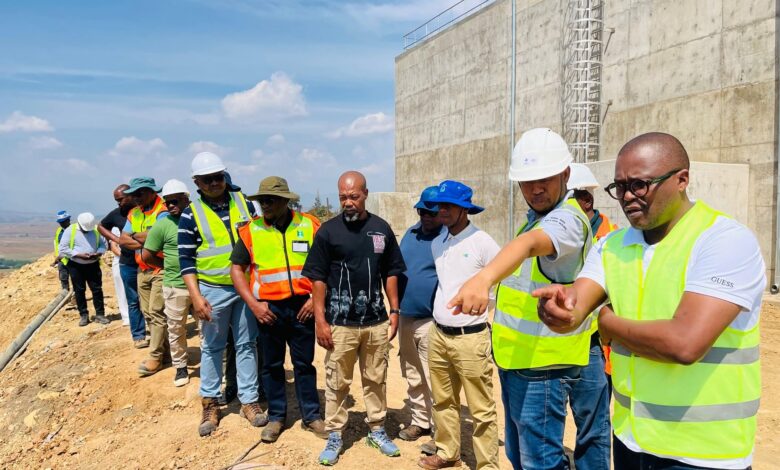
The Lesotho Lowlands Water Development Project Phase II is making significant progress, with construction works at key water infrastructure sites reported to be approximately 90% complete. The Ministry of Natural Resources Water Sector management team recently visited the ongoing works at the Ha Setene Water Treatment Plant as well as reservoirs at Khanyane and Ha Lesiamo. The visit provided an opportunity for the management team to receive an update on construction progress and assess the development of infrastructure that will support water supply in Lesotho’s northern lowlands. According to Mr Bokang Matlali, the contractor’s representative from China International Water & Electric Corporation, commonly known as CWE, the works have reached about 90% completion. Once operational, the project is expected to strengthen access to treated water for more than 100,000 people in Hlotse, Maputsoe and surrounding communities.
The Ha Setene Water Treatment Plant is one of the key components of the Lesotho Lowlands Water Development Project Phase II. The plant is expected to have the capacity to treat up to 25 million litres of water per day once it becomes operational. This level of treatment capacity is intended to support the growing demand for reliable and treated water in communities covered by the project. The plant will form part of a wider water supply system rather than operating as an isolated facility. Its treated water will be distributed through a network that includes five new reservoirs located at strategic points within the project area.
The Ministry of Natural Resources Water Sector management team’s visit comes at an important stage of the project because construction is reportedly nearing completion. At approximately 90% completion, the remaining works represent the final stage before the infrastructure can move toward operational readiness, subject to the necessary completion, testing and commissioning processes. Site visits also allow project stakeholders to receive direct information about construction activities and the condition of major infrastructure. For a large water project, progress monitoring remains important because treatment plants, reservoirs and associated distribution infrastructure must work together as one system. The visit therefore provided a practical opportunity to review progress across different parts of the project.
Mr Bokang Matlali, representing the contractor China International Water & Electric Corporation, provided the progress update during the visit. His report placed the overall construction progress at approximately 90%, indicating that substantial work has already been completed across the project sites visited. CWE is responsible for the construction works associated with the project, while government authorities have an important role in overseeing implementation and ensuring that the infrastructure meets the intended requirements. Progress updates from the contractor help project stakeholders understand the current status of construction and identify work that remains outstanding. The reported completion level also highlights the scale of development already achieved at the Ha Setene plant and associated reservoirs.
The five new reservoirs will play an important role in distributing treated water from the Ha Setene Water Treatment Plant. They are identified as Khanyane Command Reservoir, Maputsoe, Tsifa-li-Mali, Matukeng and Ha Lesiamo. These reservoirs will provide storage within the water supply system and help facilitate the distribution of treated water to communities in the project area. Water infrastructure requires more than treatment capacity because treated water must also be stored and transported before it reaches households and other users. The inclusion of multiple reservoirs is therefore an important part of the project’s overall supply network.
Khanyane and Ha Lesiamo were among the sites visited by the Ministry of Natural Resources Water Sector management team. These reservoirs form part of the infrastructure designed to receive and distribute treated water from the Ha Setene plant. The visit allowed the management team to see construction progress at the reservoirs and receive information about the work still required. The condition and completion of these facilities will be important to the performance of the wider water supply system once the treatment plant becomes operational. A treatment plant can only deliver its intended benefits when the storage and distribution components connected to it are also ready to function effectively.
The expected capacity of 25 million litres of treated water per day gives the Ha Setene plant an important role in the project’s planned water supply system. To put that capacity into perspective, 25 million litres is equivalent to 25,000 cubic metres of water per day. The actual amount of water delivered to individual communities will depend on the operation of the wider system and the distribution infrastructure connected to the plant. The treatment capacity is nevertheless a major component of the planned improvement in water supply for the northern lowlands. It is designed to serve a substantial population across Hlotse, Maputsoe and surrounding communities.
More than 100,000 people are expected to benefit from the project once the infrastructure becomes operational. The anticipated beneficiaries include residents of Hlotse and Maputsoe as well as people living in surrounding communities. Reliable access to treated water is important for households, businesses, public institutions and other users who depend on consistent water services. Improved water infrastructure can also support local economic activity by providing a more dependable water supply for different types of development. The project’s expected population reach makes its completion an important milestone for water supply infrastructure in the affected areas.
The Lesotho Lowlands Water Development Project Phase II forms part of wider efforts to improve water infrastructure in the lowland areas of Lesotho. Water demand can increase as communities grow and economic activity expands, making investment in treatment, storage and distribution infrastructure important for long-term service delivery. Projects of this scale require coordination among government institutions, contractors, technical teams and communities. Construction progress must also be monitored carefully because the different components need to reach completion in a coordinated manner. The ongoing visits by the Ministry of Natural Resources Water Sector management team provide a mechanism for receiving updates directly from those involved in implementation.
The reported 90% completion rate also means that attention will increasingly turn toward the remaining construction activities and preparations for bringing the system into operation. Completion of physical construction is an important milestone, but water infrastructure also requires appropriate testing and commissioning before it can provide services to the public. The treatment plant and reservoirs must operate as an integrated system, with water treated at Ha Setene reaching the designated storage facilities and distribution points. Operational readiness also depends on the successful completion of the infrastructure and the processes required before public supply begins. The available project update confirms the reported construction progress, but it does not establish a specific date for when the full system will begin supplying water.
For communities in Hlotse, Maputsoe and nearby areas, the expected benefits of the project are closely linked to the successful completion and operation of the new infrastructure. The planned system combines a high-capacity water treatment plant with five reservoirs to support the movement and storage of treated water. This infrastructure is intended to expand and strengthen water supply services for more than 100,000 people. The project’s progress is therefore significant not only in terms of construction but also because of its potential impact on access to treated water. Residents and other water users will ultimately experience the project’s benefits when the completed infrastructure enters operation and begins delivering services as intended.
The latest visit by the Ministry of Natural Resources Water Sector management team provides an important update on the progress of the Lesotho Lowlands Water Development Project Phase II. With construction at approximately 90% according to the contractor’s representative, the Ha Setene Water Treatment Plant and associated reservoirs are approaching the final stages of development. The planned treatment capacity of up to 25 million litres per day and the five new reservoirs are central to the project’s intended water distribution system. More than 100,000 people in Hlotse, Maputsoe and surrounding communities are expected to benefit once the system becomes operational. The progress at Ha Setene, Khanyane and Ha Lesiamo marks a significant stage in the development of water infrastructure aimed at improving treated water supply across Lesotho’s northern lowlands.
Join 'Lesotho News' WhatsApp Channel
Get breaking Lesotho news — delivered directly to your WhatsApp.
CLICK HERE TO JOIN