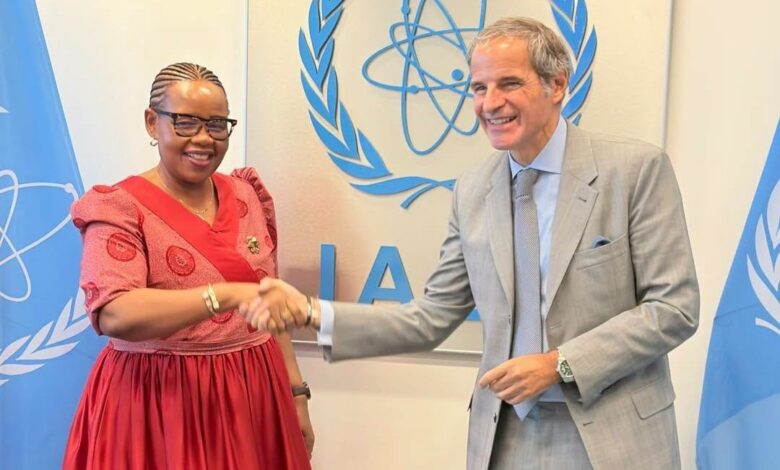
Lesotho is moving forward with plans to establish its first radiotherapy facility as the country strengthens its partnership with the International Atomic Energy Agency (IAEA). The development was discussed during a high-level meeting in Vienna between Deputy Prime Minister Hon. Justice Nthomeng Majara and IAEA Director General Rafael Mariano Grossi on the sidelines of the 70th IAEA General Conference. The meeting placed healthcare development at the centre of discussions, with radiotherapy identified as an important area where nuclear science and technology could support the health needs of Basotho. The planned facility represents a significant step in Lesotho’s efforts to expand access to specialised cancer treatment and strengthen its healthcare infrastructure. It also reflects the government’s broader interest in using international technical partnerships to address key development priorities.
The discussions between Majara and Grossi focused on the plans underway to establish the first radiotherapy facility in Lesotho. Radiotherapy uses high-energy radiation to target and destroy cancer cells and forms an important part of treatment for many cancer patients. For Lesotho, developing this capacity could reduce some of the challenges associated with accessing specialised cancer treatment outside the country. The establishment of a radiotherapy facility would also require investment in specialised equipment, trained personnel, technical systems and long-term maintenance. Continued cooperation with the IAEA could therefore play an important role in supporting Lesotho as it works to develop the technical and institutional capacity needed for such a facility.
The meeting also considered opportunities to expand IAEA support beyond radiotherapy and healthcare. Agriculture was identified as another important area where nuclear science and related technologies could contribute to national development. Nuclear techniques can support agricultural research, food security, soil and water management as well as efforts to improve crop production. Greater technical cooperation in these areas could help Lesotho strengthen scientific capacity while supporting sectors that have a direct impact on livelihoods and economic development. The discussions therefore highlighted the potential for the IAEA partnership to contribute to several areas of national development rather than focusing on healthcare alone.
Developing technical expertise in Lesotho was another key issue raised during the engagement. Advanced medical and scientific technologies require qualified professionals who can operate specialised equipment, maintain systems and apply technical knowledge safely and effectively. Building this expertise can involve training, professional development, institutional support and cooperation with international organisations. Strengthening local skills would also help Lesotho develop greater capacity to manage and sustain programmes supported through international partnerships. The focus on technical expertise therefore forms an important part of the country’s wider efforts to ensure that investments in science and technology deliver lasting benefits.
The Deputy Prime Minister reaffirmed Lesotho’s commitment to deepening its partnership with the IAEA and expanding the use of nuclear science and technology to improve the lives of Basotho. This commitment places science and technology within a broader national development agenda that includes healthcare, agriculture and skills development. The planned radiotherapy facility is particularly significant because it could create new domestic capacity for specialised cancer treatment while supporting the development of medical expertise. At the same time, expanded cooperation in agriculture and other technical fields could strengthen the practical application of scientific knowledge across the economy. The engagement in Vienna therefore demonstrated Lesotho’s intention to build on its existing relationship with the IAEA and identify additional areas where technical cooperation can support national priorities.
The discussions also underline the importance of sustained planning when introducing advanced scientific and medical technologies. Establishing a radiotherapy service involves more than acquiring equipment, as healthcare institutions must also have the appropriate facilities, safety systems, qualified professionals and operational structures in place. Long-term technical cooperation can help countries build these elements while developing the skills required to operate and maintain specialised services. For Lesotho, this approach could help create a stronger foundation for the country’s first radiotherapy facility and other future applications of nuclear technology. It also provides an opportunity to strengthen national institutions and develop expertise that can support the country beyond individual projects.
Lesotho’s engagement with the IAEA comes at a time when access to specialised healthcare and stronger technical capacity remain important development priorities. Expanding the country’s ability to use nuclear science responsibly could provide benefits across several sectors when supported by appropriate training, infrastructure and institutional systems. The proposed radiotherapy facility stands out as a major healthcare objective, while cooperation in agriculture could contribute to food security and improved agricultural practices. By continuing to work with the IAEA, Lesotho can pursue opportunities to strengthen its scientific capabilities and develop local expertise. The meeting in Vienna signals continued momentum towards using international technical cooperation to support practical development priorities and improve services for Basotho.
Join 'Lesotho News' WhatsApp Channel
Get breaking Lesotho news — delivered directly to your WhatsApp.
CLICK HERE TO JOIN