UNDP Lesotho Strengthens Commitment to Gender Equality Through Gender Mainstreaming Training

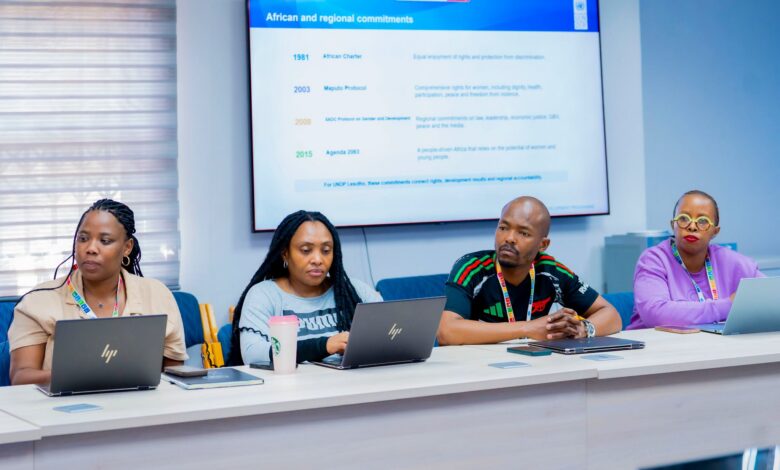
UNDP Lesotho staff recently came together for a Gender Mainstreaming Training aimed at strengthening understanding of gender equality and its role in achieving inclusive and sustainable development. The session provided an opportunity for staff to explore the organisation’s gender equality mandate and examine the new UNDP Gender Equality Strategy 2026–2029. The training also focused on what the strategy means for the daily work carried out across programmes, operations and partnerships. By strengthening staff knowledge and shared responsibility, the initiative seeks to ensure that gender equality remains an important consideration in development planning and implementation. The session reflects UNDP Lesotho’s continued commitment to creating development outcomes that benefit women, men, girls and boys more equitably.
Gender mainstreaming is important because development programmes can affect different groups in different ways. Policies and projects that do not consider gender-related barriers may unintentionally reinforce existing inequalities or fail to reach people who need support the most. Integrating gender equality into development work allows institutions to examine how programmes, resources and opportunities affect different groups before decisions are made. This approach also encourages organisations to identify barriers that may prevent women and girls from participating fully in economic, social and political life. For UNDP Lesotho, the training provided a platform to strengthen this approach across the organisation’s work.
The training focused on UNDP’s gender equality mandate and the responsibilities that come with it. Understanding the mandate helps staff recognise that gender equality is not limited to projects specifically designed for women or girls. Instead, it should inform the planning, implementation, monitoring and evaluation of development initiatives across different sectors. This includes considering gender when designing programmes, allocating resources, developing partnerships and assessing results. By making gender equality part of everyday decision-making, organisations can improve their ability to address structural inequalities and deliver more inclusive outcomes.
A central part of the session was the new UNDP Gender Equality Strategy 2026–2029. The strategy provides an important framework for strengthening gender equality within UNDP’s development work during the coming years. Exploring the strategy allows staff to understand its priorities and consider how those priorities can be translated into practical action. It also provides an opportunity for teams to examine how their existing responsibilities contribute to wider gender equality objectives. The focus on applying the strategy to daily work makes the training particularly relevant because organisational commitments become meaningful when they influence decisions and activities at operational level.
The training also reinforced the idea that responsibility for gender equality belongs to everyone within an organisation. Gender mainstreaming cannot depend only on specialists or individual teams because programmes and operations involve people across different areas of work. Staff members involved in programme design, administration, finance, procurement, partnerships and implementation can all influence whether gender equality considerations are incorporated into their work. A shared understanding can therefore help create greater consistency across an organisation. The training encouraged staff to recognise their individual roles in advancing gender equality while contributing to a collective institutional commitment.
Integrating gender equality across programmes can improve the relevance and sustainability of development interventions. When project teams understand the different needs and experiences of women and men, they can design responses that address real barriers rather than relying on assumptions. Gender-sensitive approaches can also help identify opportunities to increase women’s participation in economic activities, leadership, decision-making and access to essential services. This can strengthen the overall impact of development initiatives while ensuring that benefits reach a wider range of people. Such an approach supports the broader objective of leaving no one behind.
Gender mainstreaming also has an important role within organisational operations. Internal policies, workplace practices and decision-making processes can influence how staff experience opportunities, responsibilities and professional development. Considering gender within these areas can help organisations identify and address barriers that affect participation and progression. It can also encourage stronger accountability for equality within the workplace itself. By incorporating gender considerations into both external programmes and internal operations, institutions can align their organisational practices with the principles they promote through their development work.
Partnerships are another important area where gender equality considerations can make a difference. Development organisations often work with governments, civil society organisations, communities, businesses and other international partners to achieve shared objectives. These partnerships can create opportunities to promote gender equality through joint programmes, policies and investments. They can also help bring the experiences of women and other underrepresented groups into development discussions. Ensuring that gender equality remains part of partnership planning can therefore strengthen collaboration and improve the sustainability of development outcomes.
The training comes at a time when advancing gender equality remains closely connected to wider human development goals. Women and girls continue to face barriers in many areas, including access to economic opportunities, decision-making, education, resources and services. Addressing these barriers requires more than individual interventions because inequalities can be influenced by institutions, social norms, economic structures and policies. Gender mainstreaming provides a way to consider these factors systematically when development decisions are made. It can therefore help ensure that development progress is shared more fairly across society.
Empowering women is also an important component of sustainable development because women play central roles in families, communities, economies and institutions. When women have greater access to resources, opportunities and decision-making spaces, they can contribute more fully to social and economic development. Supporting women’s participation can also create wider benefits for households and communities. For this reason, gender equality should not be treated only as a social objective but also as an important part of effective development planning. UNDP Lesotho’s focus on empowering women reflects this broader understanding of the connection between equality and human development.
The Gender Mainstreaming Training also represents an opportunity for continued learning within UNDP Lesotho. Gender equality is a complex area that requires staff to continually examine practices, assumptions and outcomes. Training can help teams build a common understanding while creating space to discuss practical challenges and identify ways to improve their work. Continued learning can also strengthen accountability by encouraging staff to assess whether gender considerations are being reflected in actual programmes and decisions. This learning process can help turn broad commitments into measurable and sustained action.
The new UNDP Gender Equality Strategy 2026–2029 provides a framework for this ongoing work, while the training helps bring its principles closer to everyday practice. The effectiveness of any strategy depends on how consistently its priorities are incorporated into organisational decisions and activities. Staff therefore have an important role in translating strategic commitments into actions that can improve development outcomes for communities. This includes considering gender from the earliest stages of programme design through implementation and evaluation. It also requires organisations to remain open to learning, adaptation and stronger accountability.
The Gender Mainstreaming Training in Lesotho ultimately reinforces a clear message: gender equality must be integrated into development work rather than treated as a separate issue. By examining UNDP’s gender equality mandate and the Gender Equality Strategy 2026–2029, staff gained an opportunity to reflect on how their daily responsibilities can contribute to more inclusive development. The commitment to integrate gender equality across programmes, operations and partnerships can help strengthen the reach and sustainability of UNDP’s work. Continued attention to women’s empowerment can also help create opportunities for women to participate more fully as drivers of human development. As UNDP Lesotho continues this learning journey, the training provides a foundation for turning gender equality commitments into practical action that supports more equitable and sustainable development outcomes.
Join 'Lesotho News' WhatsApp Channel
Get breaking Lesotho news — delivered directly to your WhatsApp.
CLICK HERE TO JOIN