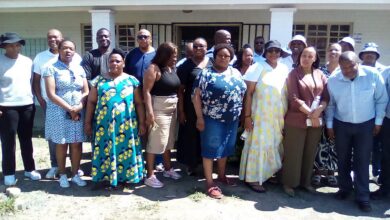

In the drought-prone lowlands of Lesotho, farmers are rewriting the story of survival through climate-smart agriculture (CSA). Faced with erratic rainfall and rising heatwaves, smallholder farmers are adopting new practices that combine traditional knowledge with modern innovations to protect harvests, save water, and strengthen food security.
Mafeteng district, one of the areas hardest hit by recurring droughts, has become a hub of resilience. Farmers here are embracing drought-tolerant crops, efficient irrigation systems, and soil conservation techniques. Their success demonstrates how determination and innovation can change the outlook for agriculture in Lesotho.
When rains failed in 2020, many in Thabana-Morena abandoned cabbage cultivation. Yet 29-year-old Thapelo Machachamise refused to give up. He invested in a drip irrigation system, a 22,000-litre storage tank, and shade nets. Today, he produces at least 10,000 cabbages annually, supplying markets as far as Maseru.
“Drip irrigation has been a game-changer. It saves water and prevents crop failure. I encourage other farmers to try it because it works,” he says. His farm has become a local model of resilience and opportunity.
Veteran farmer Letuka Lehana has taken a different route. Instead of focusing on vegetables alone, he grows sorghum alongside potatoes, tomatoes, and cabbage. Sorghum, a crop naturally adapted to Mafeteng’s climate, anchors his strategy. He also applies compost manure, practices crop rotation, and plants in basins to trap water.
“Farming today is not just about planting and hoping for rain. We must prepare the soil properly and choose crops wisely,” he explains. For him, soil fertility is the foundation of resilience.
Lesotho’s dependence on agriculture is significant, with nearly 80 percent of the population relying on it for food and income. However, climate change has made traditional farming practices less reliable. To respond, the government developed a CSA profile that promotes conservation agriculture, agroforestry, and climate-resilient crops.
According to Moiketsi Lekhanya, Area Technical Officer (Irrigation) at the Ministry of Agriculture, CSA is essential. “We have seen the effects of climate change, from prolonged droughts to sudden floods. That is why we promote conservation agriculture, water harvesting, and integrated pest management,” he says. The ministry is training farmers and extension officers to spread these practices more widely.
Partnerships are also driving progress. The Food and Agriculture Organisation (FAO), working with the Ministry of Agriculture and the National Curriculum Development Centre, has supported CSA education since 2015. More than 300 schools have joined initiatives such as art competitions, linking climate awareness to farming and nutrition. An FAO representative noted that teaching children about climate and food security helps spread the message into households and communities.
Despite challenges like high input costs and limited financing, the adoption of CSA practices is growing. Techniques such as mulching, composting, shade-net farming, and crop diversification are showing measurable results. Farmers argue that affordable credit, better extension services, and local knowledge-sharing are needed to accelerate progress.
Sorghum, once dismissed as a poor man’s crop, is gaining new respect as a climate-resilient staple. Compost manure, once overlooked, is valued again for improving soil fertility without costly chemicals. And technologies like drip irrigation are bridging the gap between uncertainty and surplus.
“Farming has always been tough here. But if we take care of the soil, plant wisely, and save water, we can overcome even the drought,” says Lehana, surveying his fields.
The message from Mafeteng farmers is clear. Climate change may be unstoppable, but adaptation is within reach. As Machachamise sums it up: “We cannot stop the drought. But we can learn to live with it. That is what climate-smart farming is all about.”
For Lesotho, where agriculture sustains the majority, scaling up climate-smart practices is no longer optional. It is the path to resilience, stronger harvests, and a more food-secure future.
Join 'Lesotho News' WhatsApp Channel
Get breaking Lesotho news — delivered directly to your WhatsApp.
CLICK HERE TO JOIN