Press Release: UN, Government join forces to boost Lesotho’s drought response
7th May 2019 – Maseru. According to the findings of the June 2018 Vulnerability Assessment and Analysis (VAA) and Integrated Food Security Phase Classification (IPC) conducted by the Lesotho Vulnerability Assessment Committee (LVAC) in June 2018, the number of people in need of assistance slightly increased compared to 2017 and it was projected to be 308,966 during the lean season (October 2018-February 2019) and respectively 18% of the rural population (257,283 people) and 9.2% of the urban population (51,683 people). Moreover, in the projected period September 2018-February 2019, Mohale’s Hoek, Qacha’s Nek and Quthing districts were classified in IPC Phase 3 (Crisis) or higher while the other districts were projected in IPC Phase 2 (Stressed).
Due to the reportedly deteriorating humanitarian situation, the Disaster Management Authority (DMA), LVAC and partners launched a countrywide rapid assessment on 1 March 2019, to better evaluate the current humanitarian needs in different key sectors, including Agriculture and Food Security, Health and Nutrition, WASH, Protection (including GBV, Migration and Child Protection), HIV/AIDS, etc.
Based on the Rapid Assessment results presented on 1st April 2019 – 407 191(28%) rural population in need of Humanitarian assistance. An increase from 273 635 (19%) from IPC update results (Nov 2018) and 257 283 (18%) from May 2018 VAA results. 80 666 (15%) urban population in need of Humanitarian Assistance. An increase from 51,683 (9.2%) from VAA results (May 2018). Food security is anticipated to deteriorate further for the next consumption beyond June 2019 (July 2019 to June 2020) and food insecure populations to increase.
The findings of the Rapid Assessment have revealed that current food insecurity situation is deteriorating compared to VAA results (May 2018) marked by: • Increasing number of food insecure population for the period March to May 2019. • Compromised food consumption reflected through high proportion of households with poor food consumption scores, low dietary diversity, households experiencing moderate to severe hunger, adopting stress, crisis and emergency coping strategies with the aim to fill existing food gaps • The above Indicative of the negative impact of drought experienced since the start of the current agricultural season. • The results further indicate that water situation is currently not normal as indicated by increasing number of households getting drinking water from unprotected sources. • Migration rate to RSA increasing with those who migrated reported that they were responding to existing lack of food and water. • Some household reported child marriage, Child labour, sexual offence and GBV as result of drought impact in the affected households.
Early action by UN Lesotho
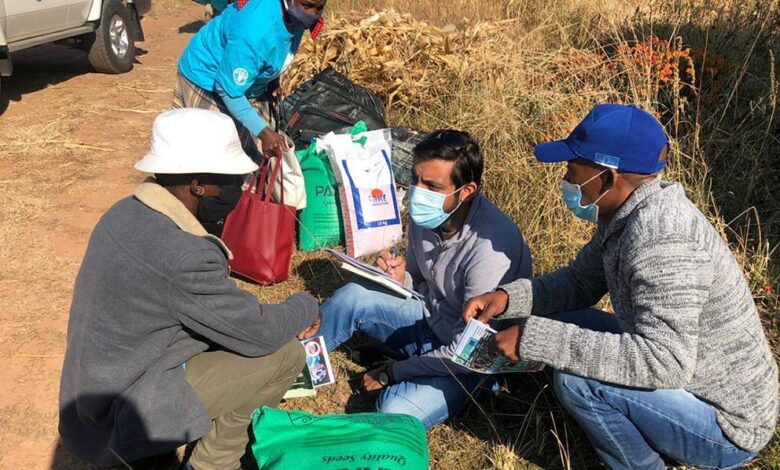
Based on the information above the the UN in Lesotho undertook early action to deliver urgent lifesaving multi-sectoral emergency assistance to severely food insecure households and to address the impacts of drought and erratic rainfall that are affecting the population in Mohale’s Hoek, Maseru, Quthing and Qacha’s Nek districts. In January 2019, UN agencies IOM, FAO, UNICEF, UNFPA, WFP and WHO jointly with national partners and through “delivering as one” mobilized USD 5,550,533 from the UN Central Emergency Response Fund (CERF) to address priority humanitarian needs in nutrition; water, sanitation and hygiene; agriculture; food security; health; and protection. Projects funded under this modality are expected to be implemented until June 2019.
Joint UN-Government of Lesotho Field Visit Consequently, the UN and the Government of Lesotho will undertake a Field Visit to the districts in IPC 3 (Crisis) or 4 (Emergency), to adequately understand the cumulative effects of the recent erratic weather patterns and related hazards in the short, medium and long term in different sectors, Agriculture and Food Security, Health and Nutrition, WASH, Protection (including GBV, Migration and Child Protection), HIV/AIDS, etc. The field visit will commence on Wednesday, 8th May to Mohale’s Hoek and Thursday, 9th May to Quthing. Media participation The media is invited to the following events:
Join 'Lesotho News' WhatsApp Channel
Get breaking Lesotho news — delivered directly to your WhatsApp.
CLICK HERE TO JOIN